October 7, 2026
AC Not Cooling? 7 Reasons Your Air Conditioner Isn't Keeping Up in NWA Summer
It's 2 p.m. on a Tuesday in late July. Your thermostat reads 82°F inside. You set it to 72°F four hours ago. The air conditioner is running — you can hear it, feel the faint airflow from the vents — but your house feels like the inside of a parked car.
You check the vents. Air is coming out. You check the thermostat. It's set right. You walk to the unit outside and it's humming along like nothing is wrong.
But something is clearly wrong.
This scenario plays out in thousands of NWA homes every summer — in Fayetteville ranch houses, Rogers new-builds, Springdale split-levels, and Bentonville craftsman homes alike. Northwest Arkansas summers are no joke. When humidity sits in the 70s and the heat index pushes past 105°F, an AC system that's "sort of working" is the same as one that isn't working at all.
Here's the thing most homeowners don't realize: an air conditioner that's running but not cooling is usually more expensive in the long run than one that has completely stopped. A dead system gets noticed immediately. One that limps along keeps running up your electric bill while failing to do its actual job — and the underlying problem gets worse by the day.
This guide covers the seven most common reasons NWA air conditioners stop keeping up in summer heat, what each one means for your system, and exactly what to do about each one. Some of these you can handle yourself. Others require a licensed HVAC technician. We'll be straight with you about which is which.
Why "It's Just Hot Outside" Is Almost Never the Full Answer
Before diving into the seven reasons, let's address the excuse you'll hear from some contractors: "It's just a really hot summer."
Yes, Northwest Arkansas summers are brutal. The ASOS weather station at Fayetteville Headworks recorded 76 consecutive years of data showing our July averages consistently exceed 90°F with high relative humidity. But a properly sized, properly maintained, properly charged AC system is designed to handle our climate — including our worst days.
When an HVAC technician tells you your system "just can't keep up because it's hot," that's sometimes true. But more often, it's a sign that something specific is wrong and they either didn't find it or didn't want to explain it. A well-functioning system should maintain your set temperature on any day up to its design load, which for NWA is typically calculated around a 95°F outdoor design temperature.
If your system is struggling at 97°F when it's supposed to handle 95°F, that's a small gap. If it's struggling at 88°F, something else is going on.
Here are the seven most likely culprits — ranked by how often we see them in NWA homes.
Reason 1: A Dirty or Clogged Air Filter Is Starving Your System
This is the number-one cause of AC performance problems in residential homes, and it's the one homeowners have the most control over.
Air filters exist to protect your HVAC equipment from dust, hair, and airborne particles. But when they get clogged — and in an NWA home, that can happen in 30 days during heavy pollen season or if you have pets — the system can't pull enough air across the evaporator coil.
Here's what happens inside: the evaporator coil is where refrigerant absorbs heat from your indoor air. For that heat transfer to work, you need adequate airflow moving across the coil. A clogged filter reduces airflow dramatically — sometimes by 50% or more.
With reduced airflow:
- The evaporator coil gets too cold and can ice over (more on that in Reason 3)
- The system moves less conditioned air into your living spaces
- The compressor and blower motor work harder, using more electricity
- The system runs longer and still never reaches your set temperature.
The fix: check your filter right now. Pull it out and hold it up to a light source. If you can't see light through it, it needs to be replaced. For a typical 1-inch filter, replacement every 30–45 days is appropriate for NWA homes with pets or allergies. For 4-inch media filters, every 6–9 months is typical.
Don't upgrade to a MERV 13 filter if your system isn't designed for it. Higher-MERV filters trap more particles but also restrict more airflow. Unless your HVAC technician has confirmed your system can handle the static pressure, a MERV 8 or 10 is usually the sweet spot for most residential systems.
A clean filter costs less than $10. A service call because you ignored the filter for six months costs significantly more — and causes real damage to the equipment.
Reason 2: Your Outdoor Condenser Unit Is Dirty or Blocked
Most homeowners never think about the outdoor unit. That's exactly the problem.
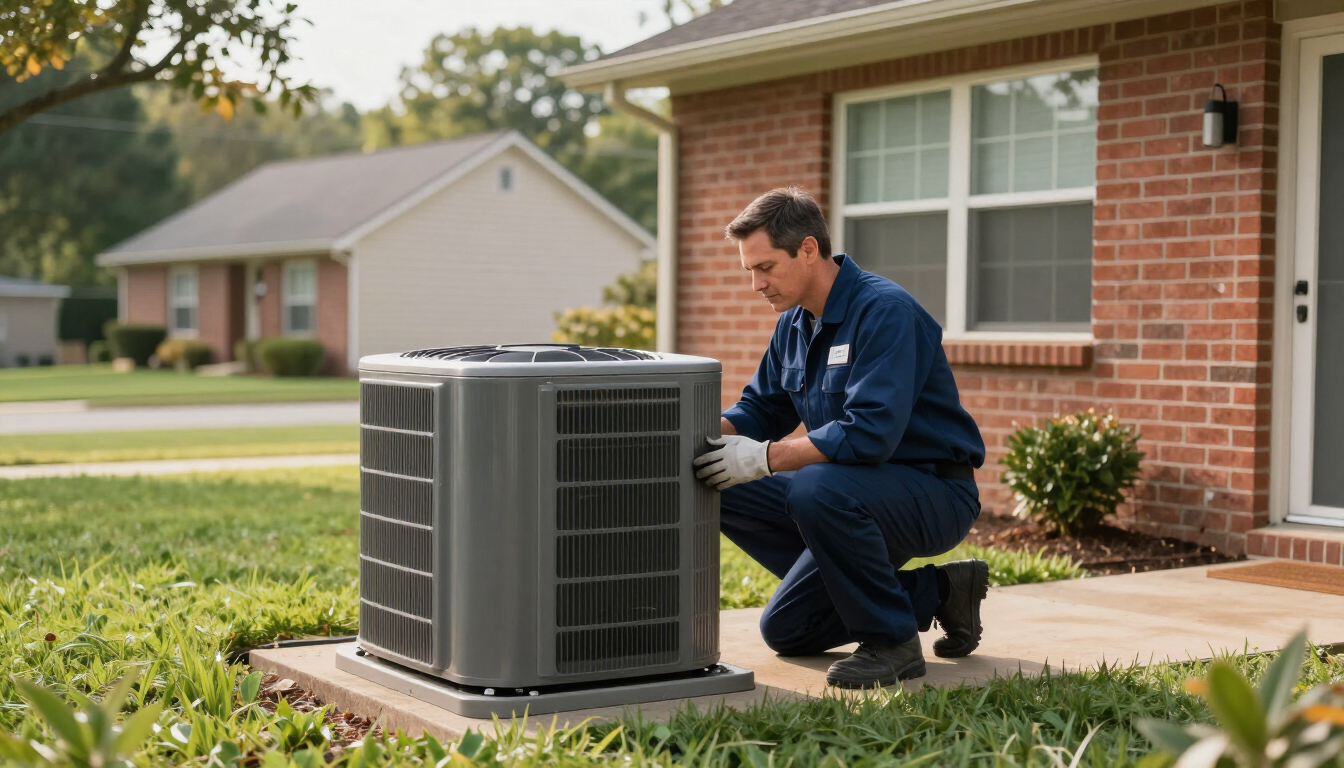
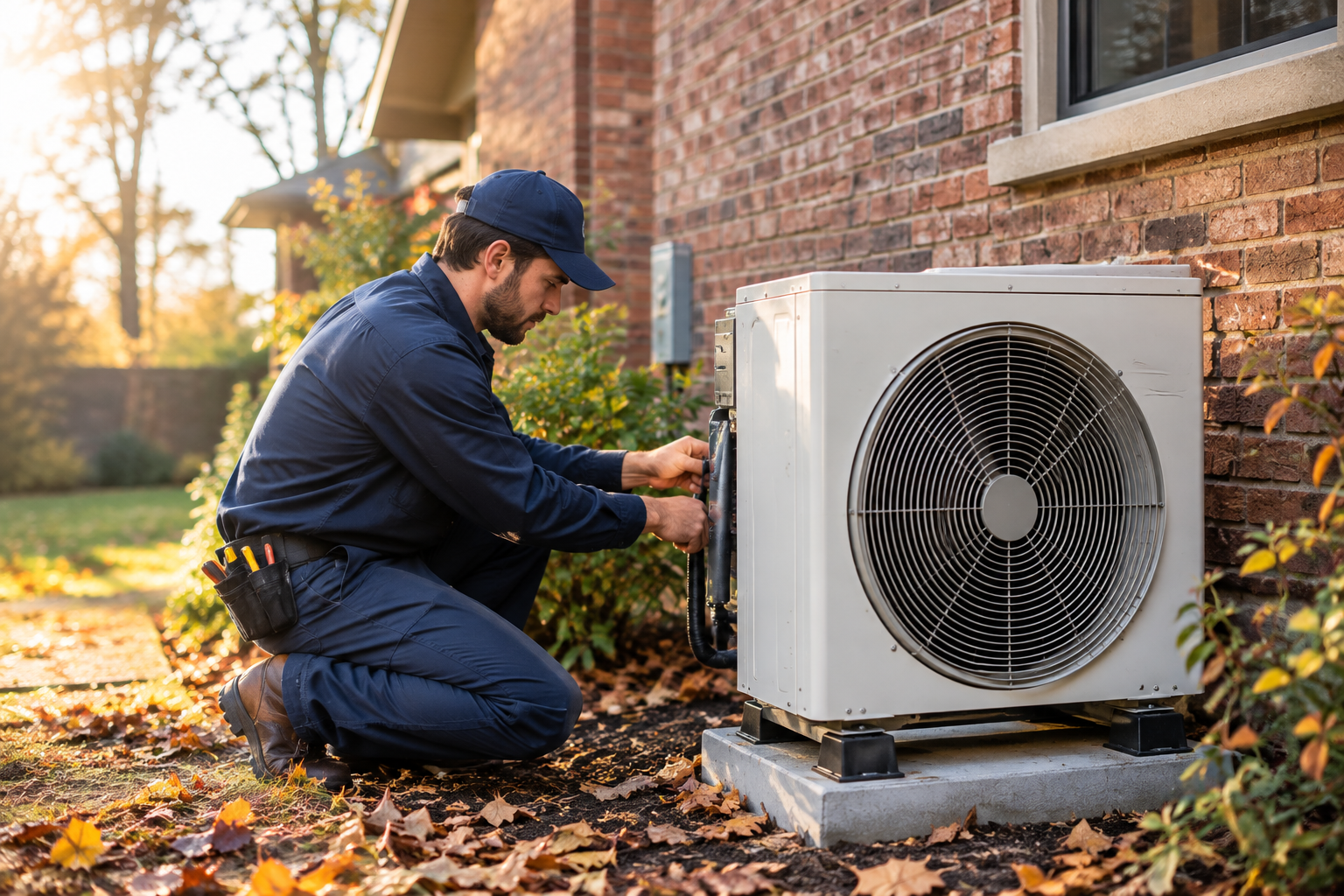
The condenser unit — that metal box outside your home with the fan on top — is responsible for releasing the heat your system pulls from your indoor air. It does this by pushing outdoor air through aluminum fins that surround refrigerant coils.
When those fins get clogged with grass clippings, cottonwood fuzz (a real issue in NWA from May through July), dirt, or debris, the condenser can't release heat efficiently. The refrigerant leaves the condenser still carrying heat it was supposed to dump. It cycles back into your home warmer than it should be. Your house doesn't cool down. Your system runs constantly.
Beyond debris: check for vegetation. NWA landscaping — butterfly bushes, ornamental grasses, boxwoods — loves to creep toward HVAC equipment. We've seen condenser units with shrubs growing through the fins. The manufacturer recommendation is at least 18 inches of clearance on all sides and 5 feet above the unit.
What to do:
- Gently rinse the fins with a garden hose from the inside out (yes, from the inside — open the top if you can, or spray from slightly above). Never use a pressure washer, which bends fins permanently.
- Trim any vegetation to maintain clearance
- Make sure there are no leaves, mulch, or ground cover piled against the base
A professional AC tune-up (our Total Breeze Club membership includes annual maintenance visits) will include a full condenser coil cleaning with professional-grade coil cleaner that does a better job than a garden hose. But a basic rinse between tune-up visits is something every homeowner can do.
Reason 3: Your Evaporator Coil Is Frozen — Yes, Even in July
Counterintuitive but common: your AC can literally freeze in the middle of an Arkansas summer.
The evaporator coil (the indoor coil, typically inside your air handler or on top of your furnace) operates at very low temperatures — usually around 40°F. If something disrupts the heat exchange process, that coil can drop below freezing and accumulate ice.
When ice builds up on the coil, it acts as an insulator. Refrigerant can't absorb heat from your air. Your system moves little to no cold air into your home while running continuously. If it goes on long enough, ice can migrate down the refrigerant lines and potentially damage the compressor — your most expensive component.
Signs your coil is frozen:
- Vents producing little to no airflow despite the system running
- Ice visible on the refrigerant lines coming out of your air handler
- Water pooling around your indoor unit (ice melting when the system cycles off)
- Warm or room-temperature air from supply vents
Common causes of coil freezing in NWA homes:
- Dirty air filter (see Reason 1) — insufficient airflow is the #1 cause
- Low refrigerant — we cover this in Reason 4
- Blocked supply or return vents — furniture pushed against registers, closed vents in unused rooms
Blower motor failing — the fan that moves indoor air isn't spinning fast enough.
What to do if you suspect a frozen coil: turn the system to FAN ONLY mode (not "Cool" — just "Fan") and let it run for 2–4 hours to thaw. Then replace or check your filter. If the coil freezes again after thawing, call a technician — there's an underlying cause that needs diagnosis. Don't keep cycling the system on and off trying to force it to cool; you risk compressor damage.
Breeze Heat & Air handles frozen coil diagnoses across all of Northwest Arkansas, including emergency HVAC service for days when thawing the coil isn't enough and the underlying problem needs immediate attention.
Reason 4: Your System Is Low on Refrigerant
This one gets misunderstood constantly, so let's be clear about how refrigerant actually works.
Refrigerant doesn't get "used up" like fuel. An AC system is a closed loop — if it's low on refrigerant, that means refrigerant leaked out somewhere. The leak is the problem. Adding refrigerant without finding the leak is a temporary fix that buys you weeks or months before the same problem returns.
R-410A — the refrigerant in most NWA systems installed between 2010 and 2022 — is under a phase-down right now under the AIM Act. Supply has tightened significantly since 2023, and prices have risen sharply. R-22 refrigerant (systems from the early 2000s and before) is effectively end-of-life — it's technically available but at prices that make repair vs. replacement math very different than it was five years ago.
Signs your system may be low on refrigerant:
- Warm or lukewarm air from supply vents even with the system running properly otherwise
- Ice on the refrigerant lines (the suction line — the larger, insulated copper line)
- System runs continuously without reaching set temperature
- Higher than normal electric bills with no other explanation
Bubbling or hissing sounds from the refrigerant lines (a sign of active leaking).
What NOT to do: don't let anyone add refrigerant without leak testing first. EPA Section 608 requires certified technicians to find and repair leaks over a certain size before recharging. If a contractor offers to "just top it off" without checking for leaks, that's not legitimate service.
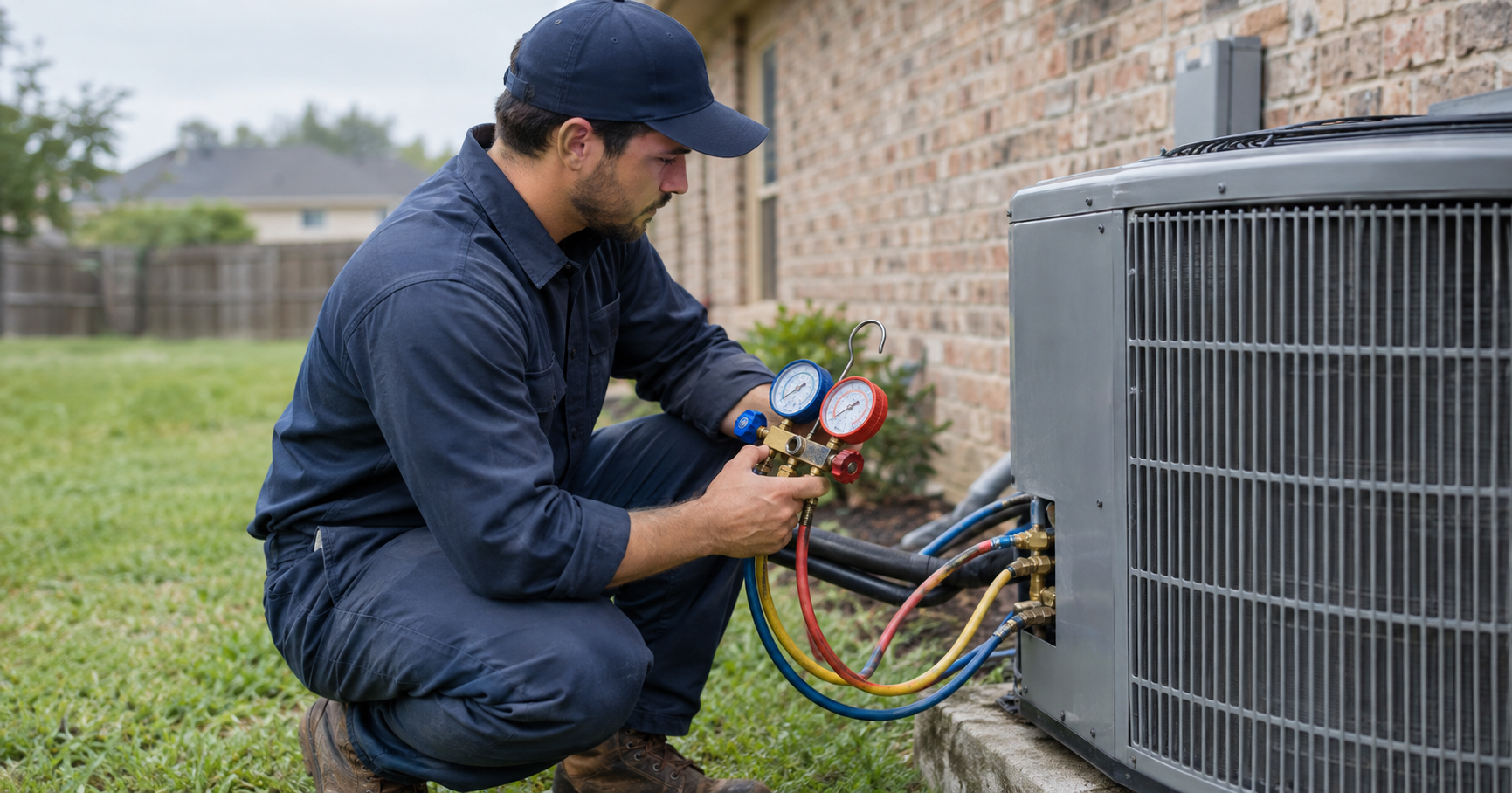
What a proper service call includes: a technician checks system pressures, performs a leak search (electronic leak detector and/or UV dye), repairs the leak if accessible, and recharges to the manufacturer's specified refrigerant charge. Some leaks — particularly in evaporator or condenser coils — may make repair cost-prohibitive depending on system age, at which point HVAC replacement becomes the better conversation.
Reason 5: Your AC Is the Wrong Size for Your Home
Bigger is not better. An oversized AC is one of the most common problems in NWA homes, and it's often invisible until you know what to look for.
Proper HVAC sizing requires a Manual J load calculation — a formal engineering process that accounts for your home's square footage, ceiling height, insulation R-values, window area and orientation, duct leakage, and local climate data. When that calculation is done right, you get a system that runs in sustained cycles, reaching your target temperature consistently.
When it's skipped — and in the NWA construction boom of the early-to-mid 2000s, it often was — contractors frequently installed systems based on rules of thumb like "1 ton per 500 square feet." That approach doesn't account for how differently a 2,000-square-foot home with cathedral ceilings, south-facing windows, and poor attic insulation performs vs. a 2,000-square-foot home with normal ceilings and good insulation.
Oversized system problems:
- Short-cycles: the system blasts cold air for 10 minutes, satisfies the thermostat, then shuts off. This happens before adequate dehumidification occurs.
- Humidity stays high even with temperature satisfied. You'll feel clammy and uncomfortable at 72°F.
- Components wear faster from constant starts and stops
- Uneven temperatures between rooms — some too cold, some too warm.
Undersized system problems:
- Runs continuously on hot days and never catches up
- Never reaches set temperature on design-load days (95°F+)
- Higher wear and utility costs from constant operation
If your system short-cycles aggressively (under 10 minutes per cycle on hot days), runs seemingly forever without reaching temperature, or you notice significant humidity problems despite the AC running, sizing deserves investigation. This is worth discussing with your HVAC contractor during a service call — any good tech can assess whether your equipment matches your home's load.
Reason 6: Your Ductwork Is Leaking Conditioned Air Into Your Attic
In older NWA homes, leaky ducts are a performance killer hiding in plain sight — or rather, hiding where you can't see them.
Most NWA homes built before 2010 have ductwork running through unconditioned attic space. That attic hits 140–160°F on July afternoons. If your supply ducts have gaps at joints, disconnected flex duct sections, or thin/deteriorated insulation, the conditioned air your system works hard to produce gets partially dumped into your 150-degree attic before it reaches your living room.
Studies from the Department of Energy suggest typical homes lose 20–30% of their conditioned air through duct leaks. In worst-case scenarios — particularly homes from the 1980s and 1990s with older duct systems — it can be significantly higher.
Symptoms of significant duct leakage:
- Rooms far from the air handler (master bedroom additions, bonus rooms over garages) that never cool properly
- Extremely high utility bills with no other obvious cause
- Dusty rooms with vents that seem to have weak airflow
- Attic that feels noticeably more humid or cooler than it should (your conditioned air is going there)
Duct sealing and ductwork repair is often one of the highest-ROI HVAC investments available — addressing performance problems without requiring equipment replacement. The diagnostic tool is a duct blower test (also called a duct leakage test), which pressurizes the duct system and measures how much air escapes. If leakage is significant, sealing with mastic sealant or metal tape (not regular duct tape, which fails quickly in attic heat) can dramatically improve system performance.
Rheem systems paired with properly sealed ductwork perform substantially better than the same equipment with leaky ducts — which is why we evaluate duct condition alongside any HVAC installation or replacement we perform.
Reason 7: Your System Is Simply Too Old to Handle NWA Summers Anymore
Equipment wears. Efficiency degrades. What worked in 2005 isn't operating the same way in 2026.
Central air conditioning systems have a design life of approximately 15–20 years under normal conditions. NWA's climate — hot, humid summers with high run times, followed by cold winters — is hard on equipment. Systems in homes where maintenance was inconsistent or deferred age faster.
Age-related decline isn't always dramatic. It's gradual efficiency loss — a compressor that's lost some of its pumping capacity, a coil with accumulated fouling that reduces heat transfer, a blower motor that's developed bearing wear and isn't moving as much air as it should. The system runs, it produces cold air, but it just can't maintain 72°F when it used to.
Signs your system's age is catching up with it:
- System that always kept up before now struggles on days that used to be manageable
- R-22 refrigerant system (manufactured before 2010, typically) — parts availability and refrigerant supply make repairs increasingly expensive
- Compressor cycling on/off protectively (short-cycling) on hot afternoons — a sign it's overheating
- Technicians finding multiple issues at once rather than one clear problem
- Utility bills that have increased year-over-year without lifestyle change explanations
The decision between repair and replacement for an aging system involves more than just the current repair cost. It involves refrigerant availability, efficiency trajectory, warranty status, and realistic remaining life expectancy. A Rheem system installed by a Rheem Pro Partner like Breeze Heat & Air comes with a 10-year parts warranty when registered within 90 days — a meaningful long-term protection that older systems no longer carry.
If your system is over 15 years old and struggling, getting a replacement assessment alongside any repair conversation makes sense. You may repair a $1,500 problem only to face a compressor failure six months later.
Emergency Situations: When to Call Immediately vs. Wait
Not every performance problem is urgent. Here's a quick guide:
Call same-day / emergency service if:
- Your system has completely stopped producing any cold air during a heat advisory (NWA heat advisories trigger when heat index exceeds 105°F — common in July and August)
- You smell burning from vents or the unit
- You have elderly family members, infants, or individuals with medical conditions in the home
- Your indoor temperature has risen above 85°F despite a running system
- You hear grinding, banging, or screeching from the equipment
Can wait for next available appointment:
- System is slightly underperforming but maintaining something below 80°F
- You've just replaced the filter and system is improving
- Performance issue only appears during the absolute hottest part of the day (2–5 p.m.)
- Issue is intermittent rather than constant
Breeze Heat & Air provides emergency HVAC service across all of Northwest Arkansas, including Fayetteville, Rogers, Bentonville, Springdale, Tontitown, Lowell, Farmington, Cave Springs, Siloam Springs, Pea Ridge, Gravette, Prairie Grove, Johnson, and Elm Springs. Call 479.318.0107 — we prioritize calls based on vulnerability and severity.
Frequently Asked Questions
Why is my AC running but not cooling the house?
The most common reasons are a clogged air filter, dirty condenser coils, a frozen evaporator coil, or low refrigerant. Start by checking and replacing your filter. If that doesn't help within a few hours, call an HVAC technician for a diagnostic — there are multiple possible causes and they require different solutions.
Can I add refrigerant to my AC myself?
No — legally or practically. Purchasing refrigerant requires EPA 608 certification. More importantly, adding refrigerant to a leaking system without finding and fixing the leak is a waste of money that gives you temporary improvement before the same problem recurs.
Why does my house feel humid even when the AC is running?
Short-cycling is the most common culprit — an oversized system that reaches the temperature set point too quickly and shuts off before running long enough to dehumidify. High humidity can also indicate refrigerant issues, dirty coils, or duct problems. Northwest Arkansas's summers pull heavy moisture from the Gulf of Mexico, and your AC has to run sustained cycles to pull that moisture out.
How often should I have my AC serviced in NWA?
Once per year minimum — ideally in spring before summer heat arrives. Our Total Breeze Club membership includes annual tune-ups plus priority service scheduling, which matters a lot during the peak July–August period when technician availability tightens across NWA.
My AC is 12 years old and underperforming — should I repair or replace?
At 12 years, it depends on what's wrong. A refrigerant recharge on a system with a minor, fixable leak is reasonable. A compressor replacement on a 12-year-old R-410A system is a harder call — you're spending money on a system with 3–8 years of life left. Request a replacement quote alongside any major repair estimate so you can compare total cost of ownership.
What temperature should my AC keep my house at in extreme NWA heat?
A properly functioning system should maintain whatever temperature it's set to, up to about a 20–25°F difference from outdoor temperature. If it's 97°F outside, maintaining 72°F indoors (a 25°F split) is at the edge of typical design capacity. If it's 90°F outside and you can't get below 80°F, something is wrong — that's a 10°F split your system should handle without problem.
Why is my upstairs so much hotter than downstairs?
Heat rises, and upstairs spaces have more roof and wall exposure. But the most common culprits in NWA homes are inadequate duct supply to upper floors, duct leaks in attic runs, or insufficient insulation in the attic above upper-story ceilings. A proper diagnostic can identify whether this is a duct issue, an insulation issue, or a zoning need.
Does closing vents in unused rooms help the system cool better?
No — this is a myth that actually hurts performance. Your duct system is designed around specific static pressure levels. Closing vents increases pressure in the system, which stresses the blower motor, can cause the evaporator coil to freeze, and doesn't meaningfully redirect air to other rooms the way people assume.
How do I know if my condenser coil needs professional cleaning vs. a garden hose rinse?
If the fins are just dusty and have light debris, a gentle garden hose rinse works well for maintenance between tune-ups. If the fins are bent, clogged with cottonwood or heavy debris packed in the coil, or if the coil has biological growth (common in NWA's humid climate), professional cleaning with a coil cleaner is the right call.
What's the fastest way to cool my house if my AC is struggling on a hot NWA day?
Short-term: close blinds and curtains on south and west-facing windows (which receive direct afternoon sun), reduce internal heat sources (oven, dryer, incandescent lights), and ensure all supply vents are open and unobstructed. Long-term: address the underlying cause — because no combination of window coverings compensates for a system that needs service.
The Real Takeaway: Running Isn't the Same as Working
An air conditioner that's running but failing to cool your home is costing you money in two ways simultaneously — the electricity it's consuming and the comfort it's not delivering. Every hour a malfunctioning system runs, the underlying problem typically gets slightly worse.
The seven reasons above cover the vast majority of performance failures we see across NWA homes each summer. Several of them — filter replacement, condenser rinse, vent unblocking — are things you can address yourself in the next hour. Others require a trained technician with proper diagnostic equipment.
The most expensive mistake NWA homeowners make is waiting. A dirty filter that causes a coil to freeze for two weeks can damage the compressor. A refrigerant leak left unaddressed compounds into a failed coil. An aging system pushed past its limits on too many 100°F days develops compressor problems that end its life prematurely.
If your system is struggling right now, call Breeze Heat & Air at 479.318.0107 or schedule a service visit online. We serve all of Northwest Arkansas — Fayetteville, Rogers, Bentonville, Springdale, and all surrounding communities — with licensed technicians (LIC# 15474066) and same-day service availability for urgent situations. .
What's the issue you're dealing with? If you're not sure which of these seven reasons fits your situation, describe what you're seeing in the comments below — we're happy to point you in the right direction.
Breeze Heat and Air — LIC# 15474066 — Rheem Pro Partner — Mitsubishi Diamond Dealer — Serving all of Northwest Arkansas
HVAC Resources for Northwest Arkansas Homeowners
Expert guidance on repairs, replacements, rebates, and maintenance — everything you need to make confident decisions about your home's heating and cooling.