August 3, 2026
Should I Repair or Replace My AC in Northwest Arkansas? The Honest 2026 Guide
The Call Nobody Wants to Get in July
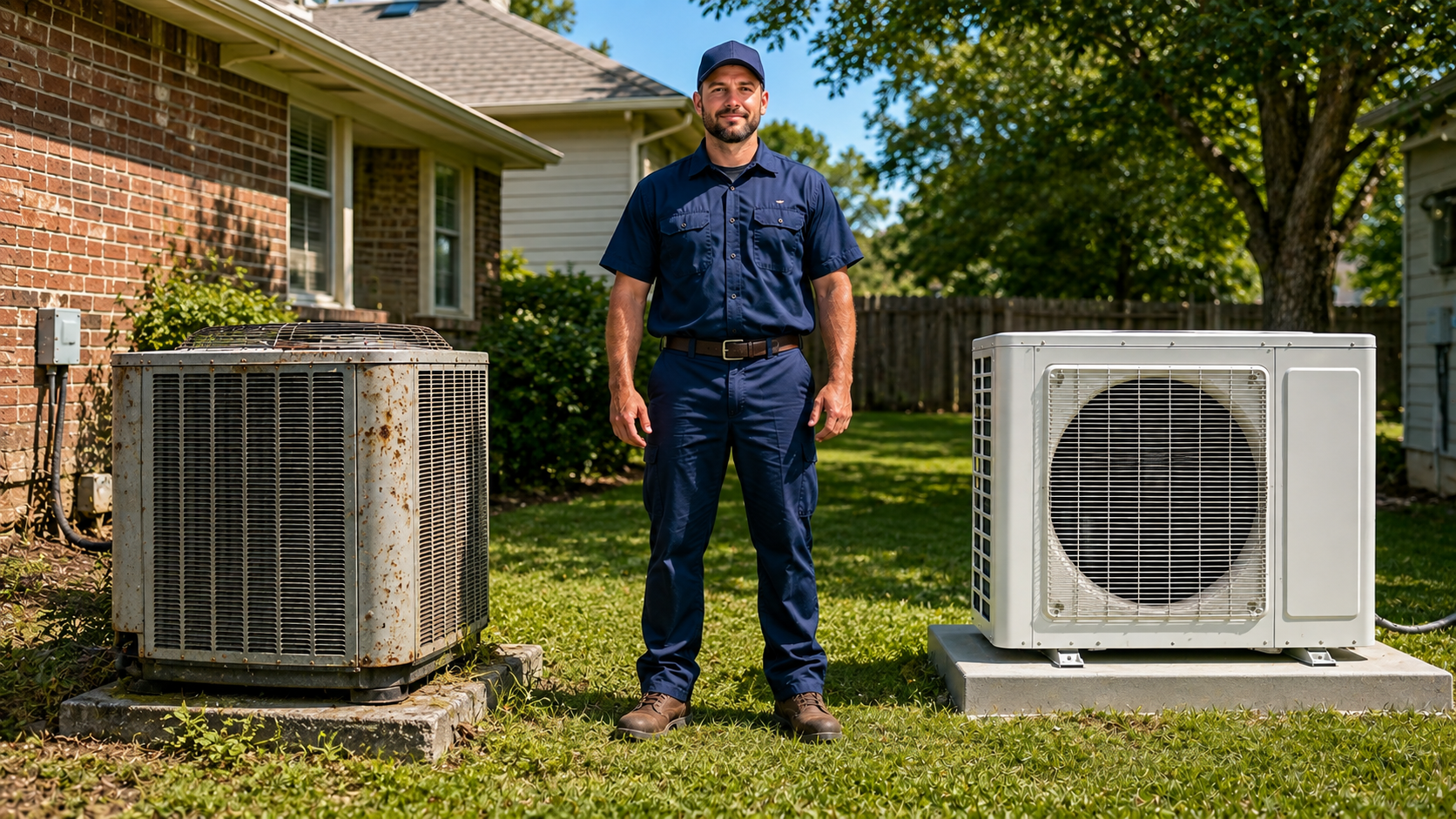
It was a Tuesday afternoon in late July — heat index hovering around 107 degrees in Fayetteville — when a homeowner got the call that every NWA resident dreads. Her AC had stopped cooling completely. The technician from a local company arrived, spent twenty minutes on the unit, and delivered the verdict: compressor failure. The quote? $1,850 to repair. She had a 13-year-old system that had already needed a capacitor replacement the previous summer and a refrigerant recharge the summer before that.
Here's the question she faced in that sweltering living room: do you spend $1,850 on a repair — on a 13-year-old unit that has already cost you two repair visits in 24 months — or do you take the leap and replace the whole system?
She called us. We talked it through. And honestly? We told her to replace it. Not because replacement is always the answer — it absolutely is not — but because in her specific situation, every data point pointed the same direction.
That decision saved her roughly $1,200 in unnecessary repair spending and dropped her monthly electricity bill by $47 the very next month.
This guide exists because that conversation happens hundreds of times every NWA summer. Homeowners get a repair quote, panic a little, and either overpay for a repair that buys them 18 months before the next failure, or rush into a replacement they did not need yet. Both mistakes cost real money. Our goal here is to give you the exact framework we use when a homeowner calls us from a hot house and needs an honest answer — not a sales pitch.
You will discover the two industry decision rules (and the critical limitation nobody talks about), the specific repair scenarios where spending money makes sense, the five warning signs that repair is just postponing the inevitable, and current 2026 NWA cost data that helps you run the numbers yourself. We will also cover the SWEPCO rebate situation, what Rheem Pro Partner status actually means for your warranty math, and the one question you should always ask any HVAC company before you authorize a repair.
Why This Decision Is Harder in 2026 Than It Was Five Years Ago
The repair-versus-replace calculation changed significantly between 2020 and 2026, and most homeowners — and honestly, some HVAC companies — have not caught up with what changed and why it matters.
This is paragraph text. Click it or hit the Manage Text button to change the font, color, size, format, and more. To set up site-wide paragraph and title styles, go to Site Theme.
Three industry shifts happened in close succession that fundamentally altered the math.
First, the federal Section 25C tax credit — which previously gave homeowners up to $2,000 back on qualifying high-efficiency HVAC installations — expired on December 31, 2025, under the One Big Beautiful Bill Act. That changes the replacement cost calculation. A homeowner replacing in 2024 had a real $2,000 federal offset working in their favor. A homeowner replacing in 2026 does not. That credit is gone for now, and no federal replacement program has been introduced as of this writing. So replacement costs more out of pocket in 2026 than they did a year ago, which genuinely tips some borderline decisions back toward repair.
Second, the refrigerant landscape shifted hard. R-22 (Freon) was banned from manufacturing in January 2020. By 2026, the remaining stockpiles are running thin and prices have climbed sharply. If your system uses R-22 and develops a refrigerant leak, the recharge cost alone can run $400 to $900 — sometimes more — for a single service call. That number used to be much lower. If you have an older R-22 system and you are facing any refrigerant-related repair, the economics of replacement look completely different than they did even two years ago. (Quick way to check: if your outdoor unit was manufactured before 2010, there is a reasonable chance it runs on R-22.)
Third, SEER2 efficiency standards now apply to all new systems. In 2023, the industry moved from SEER to SEER2 rating methodology, which uses a more rigorous real-world testing standard. Modern qualifying systems reach SEER2 ratings of 15, 16, 18, and higher. If your current system is a 10-year-old unit running at SEER 10 or 12, you are paying a meaningful efficiency penalty every single month. Upgrading from SEER 10 to a SEER2 16 system can reduce your cooling energy consumption by 30% to 40%. In NWA, where summers run long and heat indices above 100 degrees are routine, that monthly savings number adds up fast..
The key insight here is this: the repair-versus-replace decision in 2026 is not just about the immediate repair bill. It is about three simultaneous cost streams — the repair cost, the ongoing efficiency cost, and the replacement cost minus whatever rebates you can capture. Anyone who gives you a quick answer without thinking through all three is oversimplifying.
The Two Industry Decision Rules — And Their Real Limitations
Most HVAC guides give you two rules and call it a day. We are going to give you both rules, explain exactly where they work, and — more importantly — tell you where each one breaks down. Because applying the wrong rule to your situation can cost you thousands.
The 50% Rule
The 50% Rule says this: if the cost of a single repair exceeds 50% of the installed price of a new comparable system, you should replace rather than repair. It is the most widely cited standard in the HVAC industry, and for good reason — it is simple, fast, and directionally useful.
In practice, here is how it works in NWA in 2026. A standard central AC system for a 1,800-to-2,200 square foot home — which describes a huge portion of the housing stock in Bentonville, Rogers, Springdale, and Fayetteville — runs approximately $5,500 to $8,500 installed, depending on efficiency tier, brand, and whether ductwork repairs are involved. Call the midpoint $7,000. Fifty percent of $7,000 is $3,500.
So if you get a repair quote for $3,500 or more on a system that is past the midpoint of its lifespan, the 50% Rule says replace.
A compressor replacement — the most expensive single AC repair — runs $1,200 to $2,500 nationally (as of mid-2026, per HomeGuide and This Old House cost data). On a newer, still-warranted system, that repair is often worth it. On a 12-year-old system, that $1,800 compressor replacement sits at roughly 25% of replacement cost — under the 50% threshold — but the age factor makes it a much closer call than the rule alone suggests.
Here is the limitation nobody mentions: the 50% Rule only evaluates a single repair in isolation. It does not account for repair history. A $700 repair this summer, after a $500 repair last summer and a $400 repair the summer before that, represents $1,600 in cumulative spending over 36 months. That pattern changes everything — but the 50% Rule, applied to just the current quote, will tell you to repair each time.
The $5,000 Rule
The $5,000 Rule multiplies your system's age (in years) by the current repair quote. If the result exceeds $5,000, replace. So a 10-year-old system with a $600 repair quote scores 10 x $600 = $6,000 — over the threshold, pointing toward replacement. A 5-year-old system with the same $600 quote scores $3,000 — under the threshold, pointing toward repair.
The $5,000 Rule is better than the 50% Rule for one specific reason: it factors in age. An older system has less remaining useful life, so the same repair cost becomes a worse investment the older the system gets.
Where the $5,000 Rule breaks down is on larger systems or naturally expensive components. A legitimate capacitor repair on a 4-ton unit for a 2,500-square-foot home in Fayetteville might run $350. On a 14-year-old system, that scores 14 x $350 = $4,900 — just under $5,000, pointing toward repair. That conclusion is probably right. But the same rule applied to a $1,200 coil cleaning and repair on a 5-year-old system produces 5 x $1,200 = $6,000, pointing toward replacement — which is almost certainly wrong for a 5-year-old system.
Our honest recommendation: use both rules as starting filters, not final verdicts. They narrow the decision space. Then apply the additional factors below to make the call.
The Repair Scenarios Where Spending the Money Is the Right Move
Here is what nobody in the HVAC industry says clearly enough: a lot of AC repairs are completely worth it. Not every failure means you should replace the system. Some repairs are fast, affordable, and give you five or more good years of reliable cooling. Let us be specific about which ones.
Minor Electrical Component Failures
Capacitors and contactors are the most commonly replaced components in residential AC systems — and they are also among the cheapest. A capacitor replacement runs $150 to $250 all in, including labor. A contactor replacement is similar. These are 20-to-30-minute repairs on components that cost $15 to $50 as parts. If your system is under 10 years old and the failure is isolated to a capacitor or contactor, repair without hesitation.
The same logic applies to thermostat failures, control board issues on newer units, and condenser fan motor replacements on systems under 8 years old. A condenser fan motor costs $300 to $600 all in. On a 6-year-old Rheem system with no other repair history, that is a completely reasonable investment.
Refrigerant Recharges on Non-R-22 Systems
If your system uses R-410A (the standard refrigerant for units manufactured roughly between 2010 and 2022) and develops a minor refrigerant leak that can be located and repaired, the recharge cost runs $200 to $500 depending on how much refrigerant was lost and the leak repair complexity.
On a system under 10 years old with no other issues, that is worth repairing. A note for 2026 specifically: R-410A is currently in a phase-down under EPA regulations, and its price per pound is rising. Get a line-item breakdown on any refrigerant quote so you can see exactly how much you are paying per pound — and ask your technician whether the leak can be permanently repaired or whether this is a system with ongoing sealing issues.
Evaporator Coil Issues on Younger Systems
The evaporator coil sits inside your air handler and is responsible for absorbing heat from the air moving through your home. A pinhole leak in a coil on a 4-or-5-year-old system is worth repairing, especially if the system is still under the manufacturer's parts warranty. Coil replacement runs $1,000 to $2,500 all in — a significant expense, but on a young system with years of life remaining, the math supports repair.
What changes the calculation: if the coil is leaking on a 12-year-old system that also has aging ductwork, an outdoor unit showing corrosion, and a history of annual repairs, the coil becomes the final straw, not an isolated incident.
For any AC repair question in Northwest Arkansas, our AC Repair service page walks through what our diagnostic process looks like and what we check before recommending any repair.
The Five Warning Signs That Repair Is Just Delaying the Inevitable
This is the section most HVAC blogs skip entirely — or bury at the bottom. We are putting it here because recognizing these patterns early can save you one, two, sometimes three unnecessary repair bills before you make the replacement decision you were always going to make.
Warning Sign 1: Three or more service calls in the past 24 months.
This is the clearest signal in the industry. A single repair is a data point. Two repairs are a trend. Three repairs in two years means your system is entering the failure cascade phase — where one component failing puts additional strain on adjacent components, accelerating the overall decline. We have seen homeowners spend $1,700 over three summers in separate "small" repairs on a 14-year-old unit before finally replacing it. They would have saved money replacing after the second repair.
Warning Sign 2: Your system was manufactured before 2010 and uses R-22 refrigerant.
We already covered why this matters for refrigerant cost, but there is a broader point here. A pre-2010 system is 16-plus years old. The rated lifespan of a central air conditioner is 10 to 15 years with proper maintenance. If your unit has made it to 16 years, that is actually a testament to the original installation quality and your maintenance habits — but it also means you are living on borrowed time. Any significant repair on a pre-2010 R-22 system should be evaluated as likely postponing a replacement by 12 to 18 months at best.
Warning Sign 3: Your energy bills have climbed 15% or more without a change in usage habits.
This one is sneaky because most homeowners attribute higher bills to rate increases rather than equipment degradation. Arkansas's average electricity rate sits around 13.3 cents per kilowatt-hour. An older system running at SEER 10 can consume 50% to 80% more electricity than a modern SEER2 16 unit doing the same cooling work. Run your Entergy or SWEPCO bill from August 2022 against August 2025. If the trend is consistently up and you have not added square footage or changed thermostat behavior, your system is losing efficiency. That monthly cost difference is real money — and a new system pays back part of its cost through lower bills every single month.
Warning Sign 4: Your home never reaches the temperature you set, even on mild days.
An AC system that used to cool your Springdale or Bentonville home to 72 degrees and now struggles to hit 76 even on a 90-degree day is not just inefficient — it is telling you something structural is wrong. Could be refrigerant loss. Could be a failing compressor. Could be significant duct leakage. But if this condition persists after a fresh diagnostic and minor repair, the system is no longer sized effectively for your home. That is rarely fixable through repair alone. Our HVAC Installation page covers what proper load calculation looks like when we size a replacement system.
Warning Sign 5: Visible rust, corrosion, or loud mechanical noise from the outdoor unit.
Corrosion on the outdoor condenser unit is not cosmetic. It indicates moisture has been infiltrating components for years. Loud grinding or banging from the compressor — as opposed to a normal start-up sound — means internal mechanical wear has progressed beyond what repair typically addresses. A technician can clean a corroded coil, but they cannot reverse structural metal degradation. If your outdoor unit looks rough and sounds rough, the honest answer is that it is rough.
What a Replacement Actually Costs in Northwest Arkansas in 2026
Let us talk real numbers — not national averages from a generic calculator, but what homeowners in Fayetteville, Bentonville, Rogers, Springdale, and Tontitown are actually paying right now.
Standard central AC replacement (no heat pump):
A 3-ton, 16 SEER2 system installed in a typical 1,600-to-2,000 square foot NWA home runs approximately $5,500 to $7,500 all in. This includes the outdoor condenser unit, air handler or coil if needed, installation labor, refrigerant charge, and standard permits. The Bentonville-Fayetteville construction boom has pushed NWA labor rates closer to national norms over the past three years, so the days of significant Arkansas labor discounts are less pronounced in this market than elsewhere in the state.
High-efficiency upgrade (18 SEER2 or above):
Stepping up to a 18-SEER2 Rheem system adds $800 to $1,500 to the base price but meaningfully reduces your monthly operating cost. For a household running the AC 5 to 6 months of the year — which is realistic in NWA — the efficiency payback on the premium runs 4 to 7 years at current electricity rates. After that, you are ahead every month.
Heat pump replacement:
A heat pump does the job of both your AC and heating system, moving heat rather than generating it. In NWA's ASHRAE Climate Zone 4A, which includes Fayetteville, Bentonville, and Rogers, heat pumps are genuinely viable year-round. Modern cold-climate heat pumps maintain efficient operation down to 5 degrees Fahrenheit. A quality heat pump installed in NWA runs $6,500 to $10,000 all in. That is more upfront, but SWEPCO currently offers rebates of up to $3,000 for qualifying heat pump installations — and we handle all the paperwork when you use us as your installing contractor. Our Heat Pump Repair and Installation service page goes into detail on how heat pump efficiency translates to monthly bill reductions in NWA's specific climate.
Full system replacement including ductwork:
If your home has older flex ductwork with significant leakage or damage — and in NWA's hot, humid attic environments, ductwork degrades faster than in dryer climates — adding duct repairs or partial replacement to your project adds $800 to $3,500 depending on the scope. We always assess ductwork condition as part of a replacement quote, because installing a new system on leaky ducts is one of the most common and most expensive mistakes we see homeowners make. Learn more about ductwork condition and repair on our Ductwork service page.
The SWEPCO Rebate Situation in 2026 — What You Can Still Capture
With the federal Section 25C credit gone, the most meaningful available offset for NWA homeowners replacing HVAC equipment in 2026 comes from SWEPCO and Black Hills Energy.
SWEPCO serves a large portion of NWA and currently offers rebates of up to $3,000 on qualifying high-efficiency HVAC systems, including heat pumps. The exact rebate amount depends on the efficiency tier of the equipment and your specific service address. A qualifying heat pump at SEER2 15.2 or above with an HSPF2 rating of 7.5 or above falls into their highest rebate tier.
Here is the part that catches homeowners by surprise: SWEPCO requires pre-approval before installation. They do not accept retroactive rebate applications. If you hire a contractor, they install the system, and then you try to apply for the rebate, you will not receive it. This is exactly why using an approved contractor who handles the pre-approval process matters — not as a sales point, but as a practical piece of rebate mechanics.
Black Hills Energy customers in NWA can access up to $400 in rebates for qualifying furnaces. If you are on Black Hills and replacing both your AC and furnace simultaneously, that rebate stacks with equipment savings.
The federal Section 25D credit — covering geothermal heat pump installations specifically — remains active through 2032 at 30% of installed cost with no dollar cap. Geothermal is a significant upfront investment, but for the right home and property, the 30% federal offset makes the math very different.
We do not push this option for everyone, but for homeowners in rural NWA with the land footprint for a ground loop, it deserves a serious conversation. Our Indoor Air Quality and efficiency service information touches on whole-home performance upgrades that sometimes pair well with geothermal decisions.
The Rheem Pro Partner Difference — Why It Matters for Your Repair Versus Replace Math
Here is something most homeowners do not know about HVAC equipment warranties — and it genuinely affects the repair-versus-replace calculation.
When you purchase a Rheem system through a certified Rheem Pro Partner contractor like Breeze Heat and Air, you get access to extended warranty coverage that is not available through non-certified installers. Rheem's standard compressor warranty on qualifying systems is 10 years on parts when registered by a Pro Partner within 90 days of installation. That warranty coverage fundamentally changes what a compressor failure costs you in year 4 or year 6 of ownership: the part is covered, and you pay only labor.
What this means practically: if you are evaluating a repair on an older system with no remaining warranty, you are paying full retail for every part plus labor. If you replace with a Rheem system installed through a Pro Partner and experience a covered failure five years from now, your out-of-pocket on a compressor repair is $400 to $600 in labor — not $1,500 to $2,500 total. That warranty value is real money, and it belongs in the replacement decision math.
We also carry Mitsubishi Diamond Dealer status for their ductless mini-split line — which matters for NWA homeowners adding cooling to spaces the central system does not reach well, like a converted garage, a sunroom addition, or a bonus room above the garage. Our Mini-Splits service page explains when ductless is the right answer versus extending your existing system.
How to Get an Honest Diagnostic — And the One Question You Must Ask
This is the "behind the curtain" moment. Here is what actually happens at a lot of HVAC service calls, and why it matters to you.
A technician arrives, diagnoses a failed component, and quotes the repair. That process is legitimate and most HVAC companies in NWA do it honestly. But the thing the quote does not always tell you is this: what is the overall condition of the rest of the system? A compressor replacement on a 12-year-old unit fixes the compressor. It does not address the capacitor that is running at 80% capacity, the contactor that is pitting, or the evaporator coil that has developed micro-corrosion. You might spend $1,800 today and face another $600 call next summer.
The question to ask any technician before authorizing a repair: "Aside from the component you are quoting me on, what is the overall condition of the rest of the system?" A technician who walks through the outdoor unit condition, tests the electrical components, checks refrigerant pressure, and notes the coil condition before answering that question is giving you real information. A technician who shrugs and says "the rest looks fine" without specifics is not.
At Breeze Heat and Air, every diagnostic call includes a full system condition assessment — not just the failing component. We want you to have complete information before you spend money. Call us at 479.318.0107 or schedule a service call directly. We serve Bentonville, Fayetteville, Rogers, Springdale, Tontitown, Lowell, Farmington, Cave Springs, Siloam Springs, and all of Northwest Arkansas.
The Real Decision Framework — Putting It All Together
After everything above, here is the practical decision tree we walk homeowners through:
Repair is almost always the right answer when:
- Your system is under 8 years old
- The repair is a single, isolated electrical or mechanical failure (capacitor, contactor, fan motor, minor refrigerant recharge)
- The repair cost is below 30% of current replacement cost
- Your system has no repair history in the past 24 months
- The system is still under manufacturer's parts warranty
Replacement deserves serious consideration when:
- Your system is 12 to 15 years old or older
- You have had two or more repairs in the past 24 months
- The repair involves a compressor, evaporator coil, or refrigerant system on an R-22 unit
- The repair quote exceeds 50% of replacement cost
- Your energy bills have trended upward without explanation for 12 or more months
- The system struggles to reach setpoint temperature on moderate-temperature days
Replacement is almost certainly the right answer when:
- Three or more repairs in 24 months
- Pre-2010 R-22 system with any refrigerant-related failure
- Compressor failure on a system over 12 years old with prior repair history
- Visible structural corrosion on the outdoor unit
- Efficiency degradation that is costing you $60 or more per month versus a new system
A quick sidebar here: we genuinely recommend that homeowners in the "serious consideration" category get two or three quotes before deciding. Not because we do not want the business — we want to earn it honestly. But because the decision is significant enough that you should feel confident in the information you are basing it on. Our HVAC Installation page walks through what our quoting process looks like and what every quote should include.
What I Wish More NWA Homeowners Knew Before the Repair Call
After working with hundreds of NWA homeowners through this exact decision, here are the things that genuinely surprise people when we tell them.
The best time to evaluate replacement is before your system fails completely.
A system showing multiple warning signs in April — before peak cooling demand hits in June and July — gives you time to get multiple quotes, explore financing options through Synchrony Bank's approved plans, and schedule installation without emergency urgency. A system that quits on a 103-degree July afternoon gives you none of those advantages. The scarcity mindset of a 95-degree house produces worse decisions. Our Total Breeze Club membership exists partly for this reason — members get priority scheduling and early warning through their annual tune-up before summer arrives.
Financing changes the math more than most homeowners expect.
When a homeowner is weighing a $1,500 repair today against a $7,500 replacement, the $6,000 difference feels enormous — until you break it into monthly payments. Approved Synchrony Bank financing plans make a $7,500 system accessible at manageable monthly amounts. The out-of-pocket difference between repair and replace, spread over a payment plan, often becomes smaller than people assume when they first hear the replacement quote.
Your ductwork matters as much as your equipment
this above, but it deserves its own emphasis. A $7,000 new Rheem system installed on a duct system with 25% leakage will not perform like a $7,000 new system on sealed, properly sized ductwork. If you are getting a replacement quote and the contractor does not mention ductwork assessment, ask about it specifically. The Ductwork service page on our site explains what a proper duct assessment includes.
Frequently Asked Questions About AC Repair Versus Replacement in NWA
How much does AC repair cost in Northwest Arkansas in 2026?
Arkansas, homeowners pay between $95 and $2,850 for AC repairs, with the average sitting around $333 for common failures (as of 2026, per multiple cost data sources). Minor repairs like capacitor replacement run $150 to $250. Major repairs like compressor replacement run $1,200 to $2,500. Labor rates in NWA specifically have risen closer to national norms due to the regional construction labor market. Always confirm whether the service call fee is waived if you proceed with the repair.
How long do AC systems last in Northwest Arkansas?
The rated lifespan of a central air conditioner is 10 to 15 years with annual professional maintenance. In NWA's hot, humid climate — with cooling seasons running from late April through October — systems at the lower end of that range are more common than in milder climates. A system that has been professionally maintained through our HVAC Maintenance program every year will reliably outperform a neglected system.
Should I repair or replace a 10-year-old AC unit?
Ten years is the inflection point where both outcomes are legitimate depending on specifics. If the repair is minor, isolated, and under $500, repair. If the system has had prior repairs and the current quote exceeds $800, replacement deserves a serious cost comparison. Run the numbers through both the 50% Rule and $5,000 Rule, then factor in your current energy bill trend.
Does a new AC unit lower my energy bill?
Yes, meaningfully. Upgrading from a SEER 10 system to a SEER2 16 system reduces cooling energy consumption by roughly 35% to 40%. At NWA electricity rates (approximately 13.3 cents per kilowatt-hour as of 2026), that translates to $30 to $80 per month in real savings for most households depending on home size and usage habits. Over 15 years, those savings fund a significant portion of the replacement cost.
What HVAC rebates are available in NWA in 2026?
SWEPCO customers can access rebates up to $3,000 on qualifying high-efficiency heat pump installations. Black Hills Energy customers can access up to $400 on qualifying furnaces. The federal Section 25C credit expired December 31, 2025. The federal Section 25D geothermal credit remains active at 30% through 2032. Pre-approval is required before installation for SWEPCO rebates — retroactive applications are not accepted. We handle this paperwork as part of our installation process.
Is it worth repairing an AC unit that uses R-22 refrigerant?
In most cases, no — especially if the repair involves refrigerant. R-22 production and import ended in January 2020. Remaining stockpiles are expensive and diminishing. A refrigerant recharge on an R-22 system can cost $400 to $900 or more in 2026, compared to $150 to $400 for R-410A systems. If your system uses R-22 and is over 12 years old, the replacement conversation is almost always the right one to have. Check your outdoor unit's data plate — the refrigerant type will be listed there.
How do I find out the age of my AC system?
Look at the data plate on the outdoor condenser unit. It will show the manufacturer, model number, and serial number. The serial number typically encodes the manufacturing date, though the format varies by brand. Rheem serial numbers, for example, encode the week and year of manufacture in the first four digits. If you cannot decode it yourself, give us a call at 479.318.0107 — we can usually tell you the age from the model and serial number in about two minutes.
What is included in a Breeze Heat and Air diagnostic call?
Our diagnostic call includes identification of the specific failure, full electrical component testing (capacitor, contactor, control board), refrigerant pressure check, visual inspection of the evaporator coil and outdoor condenser condition, and a complete written summary of system condition — not just the failed part. We want you to make an informed decision, not a reactive one.
The Bottom Line for NWA Homeowners
That homeowner in Fayetteville with the 13-year-old system and the $1,850 compressor quote? She replaced. Her new Rheem system, installed by our team at Breeze Heat and Air, qualified for a SWEPCO rebate that brought her net cost down significantly. Her August electricity bill that year came in $47 lower than the prior August. And she is now protected by a 10-year parts warranty that means any covered component failure for the next decade costs her only labor.
That is not always the story. Some repair calls we have seen are completely worth it. A $200 capacitor on a 7-year-old system is money well spent. A $400 refrigerant recharge on a 4-year-old unit with a properly repaired leak is a smart call. This is not about pushing replacement — it is about making sure you have the complete picture before you decide.
The question of whether to repair or replace your AC in Northwest Arkansas in 2026 comes down to age, repair history, efficiency gap, current repair cost, and the specific component that failed. Run those five factors through the framework in this guide, and the right answer usually becomes clear.
If you want a straight answer from someone who will tell you honestly whether repair or replacement makes sense for your specific system — not a sales pitch, just the facts — call Breeze Heat and Air at 479.318.0107. We serve all of Northwest Arkansas, and our diagnostic call gives you the complete information you need to make a confident decision.
What has been your experience with this decision? Did you repair when you should have replaced, or replace when a repair would have held? Share your situation in the comments — we read every one, and we will give you an honest answer.
Breeze Heat and Air — LIC# 15474066 — Serving Bentonville, Fayetteville, Rogers, Springdale, Tontitown, Lowell, Farmington, Cave Springs, Elm Springs, Siloam Springs, Pea Ridge, Gravette, Prairie Grove, Johnson, and all of Northwest Arkansas.
HVAC Resources for Northwest Arkansas Homeowners
Expert guidance on repairs, replacements, rebates, and maintenance — everything you need to make confident decisions about your home's heating and cooling.