September 4, 2026
Does a Mini-Split Work in NWA Winters? The Honest Answer for Arkansas Homeowners
The Conversation at Every Estimate
We were at a home in Farmington last November. The homeowner wanted a mini-split for his finished garage — a 600-square-foot workshop he had spent two years converting into a proper workspace for woodworking. The garage had excellent insulation, a new concrete floor, and zero climate control. He had been using a portable electric heater in winter and a window unit in summer, both of which he was done with.
He was ready to pull the trigger. Then his neighbor leaned over the fence and said three words that stopped the whole conversation: "Heat pumps freeze up."
The homeowner called us that evening. He had done some research on his phone. He found one forum post from 2014 about a heat pump struggling in Vermont winters and another from an Arkansas Facebook group where someone claimed their mini-split "quit working completely" on a cold night. Now he was not sure about any of it.
We spent fifteen minutes on the phone going through what actually happens to mini-splits in NWA winters — not in Vermont, not on a theoretical cold night in Maine, but in Bentonville, Fayetteville, Rogers, and Farmington, where January averages 25 degrees Fahrenheit for the low and rarely drops below single digits for more than a day or two.
He installed a Mitsubishi H2i Hyper-Heat the following week. The workshop has been comfortable every day since, through two NWA winters including a cold snap that hit 8 degrees Fahrenheit in January 2026. He texted us a photo of his digital thermostat reading 68 degrees inside while the outdoor unit was running steadily at 9 degrees outside.
That phone conversation is what this guide is. The honest answer to whether mini-splits work in NWA winters — with real specs, real NWA temperature data, real performance expectations, and the specific equipment difference that separates the systems that thrive in Arkansas cold from the ones that actually do struggle.
You will discover exactly how modern mini-split heat pumps extract heat from cold outdoor air (and why this surprises most people), what the Mitsubishi H2i Hyper-Heat's verified cold-weather specs mean for NWA's actual winter temperature range, the five NWA situations where a mini-split is the best possible solution, the three situations where a mini-split is the wrong choice, and the installation details that determine whether your system performs beautifully or disappoints.
First — What the "Heat Pumps Freeze Up" Concern Is Actually About
The neighbor's warning was not entirely wrong. It was just about the wrong equipment category — and understanding the difference is the entire foundation of this guide.
Standard-efficiency heat pumps — including older mini-splits and current entry-level units — do experience meaningful efficiency loss below 25 to 30 degrees Fahrenheit and can struggle to maintain output below 15 degrees. Older heat pump technology had a genuine limitation at cold outdoor temperatures. The compressor was a single-speed unit that ran at full capacity or off, and at low ambient temperatures, the refrigerant circuit could not extract enough heat from the outdoor air to maintain output. Ice formation on the outdoor coil accelerated, defrost cycles consumed energy and reduced comfort, and at some temperature floor, the system genuinely could not keep a space warm.
That technology exists, and some of it is still being sold. This is why the advice to ask specifically about cold-climate specification matters enormously — not all mini-splits are the same product.
Cold-climate heat pumps — also called CCHPs, cold-climate air source heat pumps, or in Mitsubishi's case, the H2i Hyper-Heat series — are engineered from the ground up for low-ambient operation. They use variable-speed inverter compressors with enhanced vapor injection technology, optimized refrigerant circuit design, and intelligent defrost logic that addresses ice formation without sacrificing comfort. The performance difference between a standard mini-split and a cold-climate unit at 5 degrees Fahrenheit is not marginal. It is the difference between a system struggling to maintain 65 degrees inside and a system running efficiently at full rated output.
The Mitsubishi H2i Hyper-Heat — the specific product line Breeze installs as a Mitsubishi Diamond Dealer — delivers 100% of rated heating capacity at minus 5 degrees Fahrenheit and 70 to 81 percent of rated heating capacity at minus 13 degrees Fahrenheit. The system continues operating down to minus 13 to minus 14 degrees Fahrenheit before reaching its hard operating floor.
Now compare that to NWA's actual winter temperature record.
What NWA Winters Actually Look Like — The Real Temperature Data
The "heat pumps freeze up" concern makes sense if you are installing in Minnesota or Vermont. NWA's winter temperature profile is a completely different conversation.
National Weather Service records for Fayetteville over the past 76 years show the following:
Average January low temperature: approximately 28 to 32 degrees Fahrenheit, depending on the year. Average coldest night in a typical NWA winter: somewhere in the 10 to 20 degree range. Nights below 5 degrees Fahrenheit: rare — occurring in roughly one to two winters per decade during polar vortex events, and lasting one to three nights when they do.
Bentonville's climate data confirms January average lows of 25 degrees Fahrenheit, with summer high averages of 90 to 91 degrees in August. The vast majority of NWA heating hours — the heating hours that actually accumulate over a full winter — occur at temperatures between 25 and 45 degrees Fahrenheit.
At 25 degrees, the Mitsubishi H2i Hyper-Heat runs at approximately 90 to 95 percent of rated capacity. At 15 degrees, it runs at approximately 85 percent of rated capacity. At 5 degrees, it runs at 100 percent of rated capacity (this is the H2i specification — it maintains full rated output to minus 5 degrees, so 5 degrees is well within its design envelope). At minus 13 degrees — the coldest single-night temperature NWA realistically experiences during a severe polar vortex — the H2i delivers 70 to 81 percent of rated capacity.
That 70 to 81 percent at minus 13 degrees is the number that resolves the "heat pumps freeze up" concern completely for NWA. Even on the absolute coldest night NWA is realistically going to see, a properly sized H2i Hyper-Heat delivers the majority of its rated output. That is the honest performance picture. Not theoretical. Not cherry-picked. Pulled directly from Mitsubishi's published engineering specifications for the MSZ-FS series.
The inverter compressor is the technology that makes this possible. Unlike single-speed compressors that are either fully on or fully off, the H2i's variable-speed compressor adjusts its output continuously between roughly 15 percent and 115 percent of nominal capacity, modulating based on real-time demand. On a mild NWA December night at 40 degrees, it runs at low modulation — quietly, efficiently, using minimal electricity. When temperatures drop to 15 degrees and heating demand spikes, it ramps up without cycling off. The system matches NWA's actual winter demand profile rather than fighting against it.
The Defrost Cycle — What It Is, What It Feels Like, and Why It Is Normal
This is the source of 80 percent of "my mini-split quit working in the cold" stories, and it is worth spending real time on because the misunderstanding causes homeowners to panic unnecessarily.
In cold, humid weather — exactly the conditions that occur in NWA during winter — moisture in the outdoor air condenses and freezes on the outdoor unit's heat exchanger coil. This is normal physics, not a malfunction. As frost accumulates, it reduces airflow through the coil and reduces heat transfer efficiency. The system monitors this condition and initiates a defrost cycle to clear the frost before it affects performance.
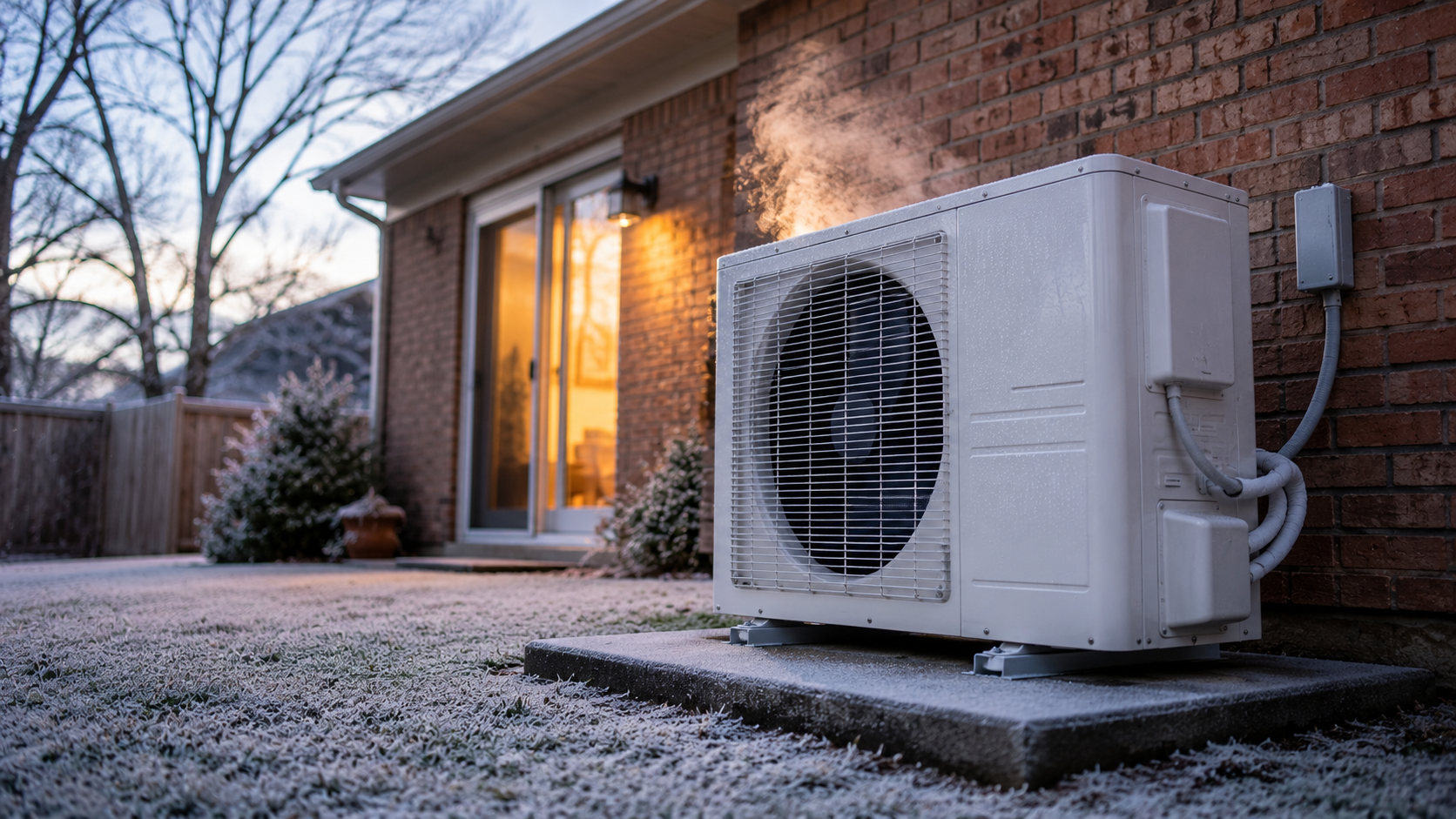
During a defrost cycle, the system briefly reverses the refrigerant flow — running the outdoor coil in cooling mode momentarily to melt the frost. This takes two to ten minutes. During that time, the indoor unit may stop producing warm air and may produce a brief puff of cool air or steam from the outdoor unit. Some homeowners see this for the first time on a cold January morning, hear a hissing sound from the outdoor unit, feel a brief cool draft from the indoor head, and conclude the system is malfunctioning.
It is not malfunctioning. It is doing exactly what it is designed to do. After the defrost cycle completes, the system returns to normal heating operation. Modern H2i systems run defrost cycles on an as-needed basis rather than on a fixed timer schedule, which reduces the frequency and duration of defrost interruptions compared to older heat pump technology.
The practical experience in a well-insulated NWA home during a defrost cycle: the room temperature drops perhaps one degree over the course of a five-minute defrost cycle. The system resumes heating and recovers to setpoint within minutes. For most homeowners, once they understand what defrost cycles are and why they occur, the experience is entirely unremarkable.
The Five NWA Situations Where a Mini-Split Is the Best Answer
Based on real NWA installation experience and the specific housing stock in Bentonville, Rogers, Fayetteville, Springdale, and Tontitown, here are the five situations where a mini-split is not just adequate — it is genuinely the best available solution for the problem.
Situation 1 — The Finished Garage Workshop or Home Gym
This is the most common mini-split application in NWA right now, and for good reason. An insulated, finished garage that is used year-round for woodworking, exercise, home office, or any other primary-use purpose needs reliable climate control. Running ductwork from the main system is expensive, complex, and often impossible without significant construction. A window unit handles summer but not winter. A portable electric space heater works but costs a fortune to operate.
A single-zone mini-split — a 12,000 to 18,000 BTU H2i unit for most NWA garage sizes — solves both seasons in one installation, qualifies for SWEPCO rebates as a heat pump, and operates at a fraction of the electrical cost of electric resistance heating. For a 500-square-foot insulated garage in NWA, plan on approximately 20 BTU per square foot of capacity — slightly higher than dry-climate sizing to account for NWA's humidity load. A 12,000 BTU unit handles garages up to roughly 600 square feet. Installation runs $2,500 to $4,500 in the NWA market for a single-zone system with a standard line set run.
Situation 2 — The Bonus Room or Bedroom That Has Never Been Comfortable
Every NWA homeowner with a two-story home from the 2000s construction era knows this room. The bonus room above the garage. The master bedroom at the end of the longest duct run. The sunroom addition where the duct connection was undersized from the beginning. These rooms are always 6 to 10 degrees warmer than the rest of the house in summer and 5 to 8 degrees cooler in winter, no matter what you do with the thermostat.
A mini-split zones that room independently, giving it its own compressor capacity and its own temperature control. The main system continues handling the rest of the house. The problem room becomes comfortable for the first time, often permanently. Single-zone installation for a bonus room runs $2,500 to $5,000 depending on the room size, access for the line set, and electrical requirements.
Situation 3 — Older NWA Homes Built Without Ductwork
Downtown Fayetteville, historic Springdale, older Rogers neighborhoods, and homes in NWA built before the 1970s often have no ductwork whatsoever. Adding a full ducted central system to an older home requires significant construction — routing ducts through walls, ceilings, and floor cavities — that can cost more than the HVAC equipment itself. Multi-zone mini-splits offer whole-home comfort with minimal construction impact: a small refrigerant line set hole through an exterior wall, one outdoor unit, and wall-mounted indoor heads in each room. For a 1,200-square-foot older NWA home, a two-zone or three-zone system covers the primary living areas without touching the home's original structure.
Situation 4 — Detached Structures That Need Year-Round Comfort
She-sheds. Guest houses. Art studios. Home offices in converted outbuildings. These structures are increasingly common across NWA's larger lots and rural-adjacent properties, and they all face the same climate control problem: too far from the main house to practically extend the duct system, too frequently used to rely on portable equipment. A mini-split with its own outdoor unit handles a detached structure cleanly — the line set runs from the outdoor unit through the exterior wall, the indoor head mounts to the wall, and the structure has independent, efficient climate control that works year-round.
Situation 5 — Supplemental Zoning in Homes Where the Central System Cannot Reach
Modern NWA homes that have been renovated, expanded, or added to often end up with spaces the original central system was not designed to condition. A screened porch conversion. A finished basement. A media room addition. Rather than replacing the entire central system to accommodate the new space — or running a long, efficiency-robbing duct extension — a mini-split conditions the addition independently while the central system continues handling the original footprint.
Our Mini-Splits service page walks through the specific applications we handle most frequently across NWA and what the assessment process looks like.
The Mitsubishi H2i Hyper-Heat — Why This Specific Equipment Changes the Winter Conversation
We have been installing Mitsubishi mini-splits across Northwest Arkansas as a Diamond Dealer for years. Here is an honest breakdown of what the H2i Hyper-Heat specification actually means for NWA homeowners — not marketing language, but engineering reality.
The MSZ-FS 12,000 BTU unit: SEER2 26.3 (cooling), HSPF2 10.4 to 12.5 depending on configuration, minimum operating temperature minus 13 degrees Fahrenheit, 100% heating capacity at minus 5 degrees. This unit handles spaces up to 600 square feet in NWA's climate. It is as quiet as 19 decibels indoors — quieter than a whisper.
The MSZ-FS 18,000 BTU unit: SEER2 21, HSPF2 10.7, minimum operating temperature minus 13 degrees Fahrenheit, heating capacity 30,000 BTU. This unit covers spaces up to 850 square feet effectively. It is the most commonly installed H2i size for NWA garages and larger bonus rooms.
For context: the minimum federal HSPF2 standard for qualifying heat pump systems is 7.5. The H2i series operates at HSPF2 10.4 to 12.5 — 40 to 67 percent more efficient for heating than the minimum qualifying equipment. That efficiency difference shows up on your electricity bill every winter month.
The 12-year compressor warranty on H2i units is the longest in the residential mini-split category. Mitsubishi does not offer that warranty casually — it reflects manufacturing confidence in the compressor's longevity under real-world operating conditions.
One specification that deserves specific mention for NWA: the Blue Fin anti-corrosion coating applied to the outdoor unit heat exchanger on H2i systems. NWA's humid summers and the oxidizing conditions around outdoor units are hard on coils over time. The Blue Fin coating extends outdoor coil service life in humid environments — a detail that matters specifically in Climate Zone 4A.
As a Diamond Dealer, Breeze Heat and Air has access to Mitsubishi's full H2i lineup with full Diamond warranty support — meaning any warranty claim on a system we install is handled through Mitsubishi's dealer network with parts coverage honored. This is not available through non-Diamond Dealer installers.
The Three NWA Situations Where a Mini-Split Is the Wrong Choice
Honest guides have to include this section. Not every NWA problem is solved by a mini-split.
Situation 1 — Primary heating for a large, poorly insulated home on a budget.
A mini-split performs brilliantly in well-insulated spaces sized appropriately for its capacity. A 1,800-square-foot older NWA home with minimal attic insulation, drafty windows, and single-pane glass in several rooms has a heating load that requires a larger-capacity solution. Multi-zone mini-split systems can handle this — but the cost climbs with zone count. A three-zone or four-zone system for a whole older home in NWA runs $8,000 to $15,000 installed. For homeowners with that budget and an older home, the comparison with a ducted heat pump or dual-fuel system is worth having before committing to ductless. Our HVAC Installation service page covers how we evaluate both options.
Situation 2 — Spaces that are genuinely uninsulated.
A mini-split in an uninsulated garage or outbuilding is fighting physics. The system will struggle to maintain setpoint in winter because heat loss through uninsulated walls and ceilings is enormous. Before installing any mini-split in a space that will be used year-round, insulate the space first. The insulation investment — typically $500 to $1,500 for a garage — reduces the required system capacity, improves efficiency, and makes the installed cost of the mini-split lower because a smaller unit can do the job.
Situation 3 — Whole-home replacement when existing ductwork is in good condition.
If your home has existing ductwork that is well-sealed, properly sized, and in good condition, a ducted central heat pump or traditional AC plus gas furnace typically delivers more cost-effective whole-home comfort than converting entirely to ductless. The ductwork is an asset. Using it with high-efficiency ducted equipment is usually the better financial decision compared to installing four or five mini-split zones to replace a functioning duct system. Mini-splits solve specific problems. Where the problem is a working ductwork system that needs updated equipment, the solution is usually updated ducted equipment.
What a Mini-Split Installation Actually Costs in NWA in 2026
Real numbers for the NWA market, based on actual project costs rather than national averages:
Single-zone, 12,000 BTU (1-ton), standard line set run:
$2,500 to $4,000 installed. This covers a Mitsubishi H2i outdoor unit, one wall-mounted indoor head, line set installation (typically 15 to 25 feet for a typical NWA application), electrical connection, condensate drain routing, and commissioning. This is the price range for a finished garage, single bedroom, or studio application.
Single-zone, 18,000 BTU (1.5-ton), standard application:
$3,200 to $5,000 installed. Covers larger garages, bonus rooms, and open-concept spaces up to 850 square feet.
Two-zone system (one outdoor unit, two indoor heads):
$5,500 to $8,500 installed. Appropriate for two-space applications — a garage and a bonus room, or two problem bedrooms served by a single outdoor unit.
Three-to-four zone multi-zone system:
$8,000 to $14,000 installed depending on zone count, line set complexity, and required electrical work.
The primary variable in NWA installation cost beyond equipment is line set length and routing complexity. A ground-floor garage with the outdoor unit adjacent to the wall is a one-hour line set run. A second-floor bonus room where the line set must route down through a wall cavity, across the exterior, and up to the outdoor unit location is a four-to-five-hour routing project. Both situations use the same equipment. Labor time drives cost difference.
SWEPCO rebates on mini-split systems:
Mini-split heat pumps qualify under SWEPCO's REIP rebate program at the same per-ton rebate rates as ducted heat pumps — $250 to $500 per ton for qualifying efficiency tiers, and $600 per ton for conversions from electric resistance heat to heat pump. A 1.5-ton (18,000 BTU) H2i at SEER2 21 qualifies for the $400 per ton tier: $600 in SWEPCO rebates on a single zone. Pre-installation reservation is required. Breeze handles this process as a SWEPCO-approved contractor. Our NWA HVAC Rebates 2026 guide covers the complete rebate process.
Installation Quality — Why It Matters More Than People Expect
This is the "behind the curtain" section that most mini-split guides skip because it makes the process sound complicated. We include it because bad installation is where most mini-split problems originate — not the equipment itself.
Vacuum and pressure testing
Before refrigerant is introduced to the line set, the system must be evacuated to a deep vacuum to remove moisture and non-condensable gases. This requires proper equipment and takes time — typically 30 to 60 minutes minimum for a properly deep vacuum. A contractor who skips or shortens this step introduces moisture into the refrigerant circuit that degrades the compressor over time. The compressor failure that happens in year four is often traceable to a five-minute vacuum instead of a proper 45-minute pull.
Condensate drain slope and routing
The indoor head produces condensate — liquid water removed from the room's air — that must drain continuously. The drain line must slope downward consistently from the indoor unit to the termination point. A drain line with a low point that allows water to pool creates biological growth, potential overflow, and water damage. In NWA's humid summers, a 12,000 BTU mini-split removes significant moisture from the air daily. That water needs a clear path out.
Line set insulation
Refrigerant lines running through NWA's hot attic environment or along exterior walls must be insulated to prevent heat gain into the suction line, which reduces system efficiency and can cause refrigerant quality issues. Properly insulated line sets are covered with foam insulation and weatherproof tape at every connection and penetration point.
Electrical sizing and breaker protection
An H2i unit must be connected to a dedicated circuit with proper breaker sizing per Mitsubishi's specifications and NWA electrical code. Undersized wiring or shared circuits create safety hazards and can cause nuisance tripping under high-load winter operating conditions.
We commission every installation with a full verification checklist — vacuum depth, refrigerant charge verification, condensate flow test, electrical measurement, indoor head level, and sound level check — before we consider a job complete. The 30-plus commissioning checks that represent proper professional installation are what separate a system that performs as specified from one that disappoints.
Frequently Asked Questions — Mini-Splits in NWA Winters
Do mini-splits work in NWA winters?
Yes, with the right equipment specification. Cold-climate mini-splits — specifically the Mitsubishi H2i Hyper-Heat series — maintain 100% heating capacity to minus 5 degrees Fahrenheit and 70 to 81% capacity to minus 13 degrees Fahrenheit. NWA's average January lows are 25 to 32 degrees Fahrenheit. The H2i operates at nearly full efficiency across the vast majority of NWA winter conditions, including polar vortex events that push temperatures into single digits.
What is the difference between a standard mini-split and a cold-climate mini-split in NWA?
A standard-efficiency mini-split begins losing meaningful heating capacity below 25 to 30 degrees Fahrenheit and may struggle to maintain comfort below 15 degrees. A cold-climate unit like the Mitsubishi H2i maintains full output to minus 5 degrees. For NWA's winter temperature profile, the H2i is the appropriate specification — not optional, but the minimum for reliable year-round performance as a primary heating source.
What is that steam or vapor coming from my outdoor unit in winter?
That is the defrost cycle — a normal, automatic process where the system briefly reverses refrigerant flow to melt frost that has accumulated on the outdoor coil in cold, humid conditions. It lasts 2 to 10 minutes, occurs as needed, and is not a malfunction. After the cycle completes, the system returns to normal heating operation.
How much does a mini-split cost to install in NWA?
Single-zone systems run $2,500 to $5,000 installed in the NWA market, depending on BTU capacity and line set complexity. Multi-zone systems run $5,500 to $14,000 depending on zone count. SWEPCO rebates of $250 to $600 per ton apply to qualifying H2i installations when installed by an approved contractor with pre-installation reservation.
Can a mini-split replace my central AC and furnace in NWA?
In some situations yes, in others no. A whole-home multi-zone mini-split system can replace a central AC and furnace for homes where ductwork does not exist or is in poor condition. For homes with functioning ductwork, a ducted heat pump replacement typically delivers better whole-home value.
Does installing a mini-split affect my existing HVAC system warranty?
No. A mini-split is an independent system that does not connect to or affect your existing central HVAC system in any way. Both systems operate independently.
How long does mini-split installation take in NWA?
A single-zone installation with a standard line set run takes 3 to 5 hours for an experienced two-person team. A multi-zone system takes one to two days depending on zone count and line set routing complexity.
Is Mitsubishi better than other mini-split brands for NWA winters?
For cold-climate performance specifically, Mitsubishi H2i Hyper-Heat is among the top two to three options on the market alongside Fujitsu XLTH and Daikin Aurora. For NWA's specific winter temperature profile, any of these three cold-climate brands perform reliably. Mitsubishi's Diamond Dealer program, 12-year compressor warranty, and the specific H2i specifications available through Breeze make it our primary recommendation. For supplemental applications — a single zone being added to a home where the central system handles most of the heating — mid-tier brands like Daikin or Rheem's ductless lineup offer solid performance at a lower price point.
Can I use a portable mini-split or DIY kit for my NWA garage?
DIY kits with pre-charged line sets (MRCOOL, for example) are available and work in some applications. However, DIY-installed units typically do not qualify for SWEPCO rebates, which require installation by an approved contractor. They may also void manufacturer warranty coverage and cannot use the H2i Hyper-Heat cold-climate specification, which requires professional refrigerant handling. For a garage that will be used year-round as a primary workspace, professional installation with SWEPCO rebate qualification is almost always the better financial decision.
The Bottom Line — Mini-Splits Work in NWA Winters, With One Condition
The Farmington homeowner texting a photo of his thermostat reading 68 degrees while it was 9 degrees outside is the answer to "do mini-splits work in NWA winters."
The condition is equipment specification. A cold-climate heat pump — specifically the Mitsubishi H2i Hyper-Heat — is designed for exactly the temperature range NWA winters produce. Standard mini-splits with lower cold-ambient ratings are a different product and a different conversation. The neighbor's "heat pumps freeze up" experience was almost certainly with a standard-efficiency unit in conditions that pushed past its design limits.
For finished garages, bonus rooms, problem bedrooms, older homes, detached structures, and room additions across Bentonville, Fayetteville, Rogers, Springdale, and all of NWA — the H2i Hyper-Heat is the answer to climate control problems that central HVAC simply cannot solve cleanly.
If you have a space in your NWA home that has never been comfortable — or a new space you want to condition without tearing into existing ductwork — call Breeze Heat and Air at 479.318.0107 or schedule a free estimate. We will assess the space, size the system correctly, handle the SWEPCO rebate reservation, and install it with the commissioning standard that makes it perform as specified for the next 15 to 20 years.
We serve Bentonville, Fayetteville, Rogers, Springdale, Tontitown, Lowell, Farmington, Cave Springs, Siloam Springs, Pea Ridge, Gravette, Prairie Grove, Johnson, Elm Springs, and all of Northwest Arkansas. LIC# 15474066.
Have you had a good — or frustrating — experience with a mini-split in NWA? Drop your story in the comments. The more specific details you share about the equipment and installation, the more useful the conversation gets for everyone else researching the same question.
Breeze Heat and Air — LIC# 15474066 — Rheem Pro Partner — Mitsubishi Diamond Dealer — Serving all of Northwest Arkansas
HVAC Resources for Northwest Arkansas Homeowners
Expert guidance on repairs, replacements, rebates, and maintenance — everything you need to make confident decisions about your home's heating and cooling.