September 4, 2026
Why Is My House So Humid in Summer? (NWA Homeowner's Guide to Indoor Humidity)
The Feeling Nobody Can Quite Explain
You walk inside from the 98-degree heat, grateful to be out of it, and something feels off. The thermostat says 74 degrees. But the air feels heavy. Your skin feels damp within minutes of sitting down. The hardwood floor near the back door has a faint sticky quality underfoot. The windows in the breakfast nook have a fine film of condensation along the bottom edge that was not there in May.
The house is technically cool. But it does not feel cool. It feels like a climate-controlled swamp.
Welcome to the specific discomfort that defines NWA summers for thousands of homeowners in Bentonville, Fayetteville, Rogers, Springdale, and Tontitown every year between June and September. The temperature problem is solved. The humidity problem is not — and most homeowners do not understand why those are two different problems with two different solutions.
Here is the reality most HVAC guides skip: your air conditioner was designed to cool your home and dehumidify it simultaneously. When the system is working correctly — properly sized, properly maintained, properly charged with refrigerant — it removes both heat and moisture in one process. When something goes wrong with any of those three conditions, or when your home has humidity sources that overwhelm what any AC can handle, the temperature drops but the moisture stays. You get cold and humid instead of cool and comfortable.
This guide covers all of it. You will understand exactly why NWA summers create a humidity problem that most of the country does not face at the same intensity. You will discover the six specific reasons your home is more humid than it should be — ranked from most to least common in NWA specifically. You will get the precise measurements that tell you whether your humidity is actually a problem or a normal seasonal variation. And you will walk away with a clear path from today's sticky discomfort to the comfort level your home is capable of delivering.
<cite index="94-1">With an average relative humidity level of 71%, Arkansas is among the top 15 most humid states in the United States.</cite> In NWA specifically, summer dew point temperatures exceed 65 degrees Fahrenheit from June through August — the threshold above which outdoor air feels uncomfortably humid even to people accustomed to warm climates. That is the baseline your home's HVAC system is fighting every single day for four months.
Why NWA Humidity Is Different — And Why It Matters for Your Home
Before we diagnose your specific situation, you need to understand the mechanics that make Northwest Arkansas summers particularly humid — because this context changes what solutions work and what solutions do not.
NWA sits at the convergence of two competing weather systems that create a specific summer humidity pattern. The Ozark Plateau, where Fayetteville, Bentonville, and Rogers sit at roughly 1,200 to 1,600 feet of elevation, is high enough to experience cooler temperatures than lower-lying Arkansas — but not high enough to escape the Gulf of Mexico moisture surge that dominates Southern summers.
Every summer, the jet stream shifts northward, removing the atmospheric barrier that normally keeps Gulf moisture from pushing into the Ozark region. When that happens — typically by early June — warm, moisture-laden air from the Gulf of Mexico streams directly into NWA. The dew point climbs. The relative humidity spikes. And the air conditioning systems in Bentonville subdivisions, Rogers neighborhoods, and Fayetteville homes start working twice as hard to manage both the heat load and the latent moisture load.
<cite index="95-1">In Bentonville, the air can feel uncomfortably humid during the summer months from June to August. This occurs when dew point temperature is above 65 degrees Fahrenheit.</cite> A dew point above 65 degrees means outdoor air carries enough moisture that human sweating — the body's primary cooling mechanism — becomes inefficient. You feel hot even when you are not. You feel damp even when you have not perspired. Indoors, that same moisture infiltrates through every gap in your home's envelope, every time a door opens, every breath of outdoor air your HVAC system draws in.
<cite index="89-1">The NWA region averages 45 to 50 inches of rainfall per year, with heavy spring storm seasons that saturate soil, stress drainage systems, and push water into crawl spaces and foundations. Summer humidity keeps moisture trapped in building materials long after the source is gone.</cite>
Understanding this baseline explains why the home humidity question in NWA is not a simple maintenance issue. It is a building science and equipment design issue that requires the right combination of solutions — not just "turn the AC down lower."
What Is the Right Indoor Humidity Level? — The Numbers That Matter
Before diagnosing why your home is too humid, you need to know what "too humid" actually means in measurable terms.
<cite index="68-1">The ideal indoor humidity range sits between 30 and 50 percent throughout the year. This range keeps your home comfortable while preventing mold growth and other moisture problems. During summer months in Arkansas, outdoor humidity often exceeds 70 percent. Your indoor levels should stay below 50 percent even when it is muggy outside.</cite>
The 30 to 50 percent target is not arbitrary. It is grounded in health and building science research that identifies the specific thresholds where comfort, health, and structural integrity converge.
Below 30 percent: air is too dry. Static electricity increases, wood furniture and flooring can crack, nasal passages and skin dry out. In NWA summers, this is rarely the problem — but worth knowing.
30 to 50 percent: the target zone. Air feels comfortable. Mold growth is suppressed. Dust mite reproduction slows. Wood and structural materials stay stable. Your body's natural cooling mechanisms work efficiently.
50 to 60 percent: the warning zone. <cite index="90-1">Dust mites thrive when indoor humidity exceeds 50 percent, reproducing rapidly in warm, moist environments. These microscopic pests live in bedding, carpets, and furniture where they feed on dead skin cells.</cite> Mold spore germination becomes more likely on cold surfaces. Condensation begins forming on supply registers and near exterior walls.
Above 60 percent: the danger zone. <cite index="92-1">Mold thrives when humidity levels exceed 60 percent — a threshold Arkansas often surpasses. According to the Arkansas Department of Health, controlling indoor moisture is the most critical factor in preventing mold growth. Mold can develop on damp surfaces within 24 to 48 hours, causing musty odors, staining, and potentially serious health risks for residents.</cite>
How to measure your home's humidity precisely: a hygrometer is a $10 to $30 device available at any hardware store or online that measures relative humidity in real time. <cite index="68-1">A hygrometer can measure your home's humidity levels accurately.</cite> Place it in your main living area away from supply vents. Check it at 3 PM on a typical summer afternoon — that reading represents your peak humidity condition. If it consistently reads above 55 percent at 74 degrees, you have a humidity problem worth addressing. If it reads above 60 percent, address it now.
Reason 1 — Your AC Is Oversized and Short-Cycling
This is the most common cause of a humid NWA home that is simultaneously cool — and it is the one that surprises homeowners most, because they cannot imagine how a bigger AC could be a problem.
<cite index="74-1">The AC system has two jobs: cooling and dehumidifying. If your unit is too big, it will cool quickly and satisfy your thermometer set point. It is called short cycling. A cycle should be long enough to allow the air in the house to mix with the conditioned air coming from the vents. When the cycle is too short, the room that has the thermostat will cool off quickly. Too quickly.</cite>
Here is the dehumidification mechanics that make this problem real. When your AC runs, warm, humid air from your home passes across the evaporator coil. The coil is cold — significantly below the dew point of the air passing across it. Moisture in the air condenses on the coil surface, drips into the condensate pan, and drains out of the house. <cite index="69-1">In NWA summer, a typical home's AC produces between 5 and 20 gallons of water every day.</cite> That water removal is the dehumidification function of your system — and it requires time. The coil needs to stay cold and in contact with humid air long enough for meaningful moisture removal to occur.
<cite index="75-1">An oversized air conditioning unit causes problems. An oversized AC unit cools the air too quickly, and then the thermostat signals the unit to shut off even though the entire space has not been properly cooled or dehumidified. This rapid cooling prevents the system from properly dehumidifying the air, leaving your home feeling cool but unpleasantly clammy.</cite>
The pattern you experience: the AC kicks on, blasts cold air for four to six minutes, hits the thermostat setpoint, shuts off, and repeats 10 to 15 times per hour. Each cycle is too short to pull meaningful moisture out of the air. You get temperature satisfaction without humidity control. The house feels cold but clammy — exactly the swamp-like condition NWA homeowners describe.
How did you end up with an oversized system? In many cases, a previous contractor sized the replacement system based on the old unit's size without performing a Manual J load calculation — the industry-standard method for determining exactly how much cooling capacity a specific home actually needs. In NWA's construction boom era, many homes were also overbuilt with extra AC capacity as a hedge against summer heat, without accounting for the dehumidification penalty.
<cite index="77-1">A smaller, properly matched system running longer cycles will keep your air drier and more comfortable than an oversized unit that blasts cold air and shuts right back off.</cite>
The fix: for a clearly oversized system with no other issues, a professional can adjust the blower fan speed to a lower setting, which slows airflow across the evaporator coil, extends coil contact time, and improves moisture removal without replacing the system. This helps but is not a complete solution for severely oversized units. The permanent fix for chronic short cycling is replacement with a properly sized system following a real Manual J load calculation. Our HVAC Installation service page covers what proper load calculation looks like and why it changes the comfort outcome of every installation we do.
Reason 2 — Your Home Has More Moisture Sources Than Your AC Can Handle
Your AC is designed to manage the normal moisture load of a typical occupied NWA home. It is not designed to manage moisture from specific internal sources that generate humidity above what normal occupancy produces.
The most common hidden moisture sources in NWA homes:
Cooking without ventilation
Boiling water produces steam at a rate that significantly elevates kitchen humidity within minutes. A household cooking dinner daily without running a range hood exhaust fan — or with a recirculating range hood that does not actually vent outdoors — adds meaningful moisture to the home's air every evening. In NWA's humid summer baseline, that daily cooking moisture accumulates rather than dissipating quickly.
Long showers without adequate exhaust ventilation
A bathroom exhaust fan running during and for 20 minutes after a shower removes the steam produced. A bathroom fan that is undersized, clogged with lint, or simply not used deposits that moisture into the home's air. Multiple occupants showering without adequate ventilation can add a gallon of water vapor to your indoor air per day.
A crawl space without encapsulation.
Many NWA homes — particularly those built in the 1990s and early 2000s — have crawl spaces with bare soil floors covered only by fiberglass batt insulation between the joists. In NWA's summer humidity, soil moisture evaporates continuously upward through the crawl space and through the floor assembly into the living space above. The EPA estimates that soil evaporation in an unconditioned crawl space can add up to 10 to 20 gallons of water per day to a home's moisture load in humid climates. That is on top of everything your AC is already managing.
Indoor plants at scale.
Individual houseplants contribute minimal moisture. A home with 15 to 20 plants in a small to medium space — increasingly common in NWA's active homeowner community — can add measurable moisture through transpiration and soil evaporation.
New construction materials off-gassing moisture.
If your home was built or significantly renovated within the past two to three years, lumber, concrete, and drywall compound all release moisture as they cure. A brand-new NWA home can take one to two full summer seasons to dry out to normal moisture equilibrium, during which indoor humidity runs higher than it will in subsequent years.
Identifying your specific sources requires going room by room with your hygrometer and noting where readings are highest. A kitchen that reads 62 percent while the living room reads 54 percent points directly to cooking or dishwasher steam. A master bathroom that reads 70 percent an hour after the last shower means the exhaust fan is not working.
Reason 3 — Your Ductwork Is Pulling in Humid Attic Air
This is the sneaky humidity driver that adds both moisture and contamination to your home's air simultaneously — and it is particularly common in NWA's attic-mounted air handler configurations.
Leaky ducts do not just let cool air out — they can also suck humid air in. When your return ducts pull in moist, unconditioned air from attics, crawl spaces, or basements, your system struggles to maintain proper indoor humidity. That can lead to mold growth inside your ducts or on your evaporator coil.
In NWA, an enormous percentage of homes from the 2000s construction era have air handlers located in unconditioned attic spaces. In July, those attics sit at 140 to 160 degrees Fahrenheit with relative humidity that varies seasonally but can spike significantly after rain events. When return duct connections in the attic develop gaps, tears, or loose connections — which happens routinely as flex duct ages and attic temperature cycles cause expansion and contraction — the air handler pulls attic air into the return stream.
That attic air is hot, potentially humid, and filled with insulation particulate, dust, and whatever biological material has accumulated in the attic space. It bypasses your filter and enters the air stream directly. Your system tries to condition air that is significantly more difficult to cool and dehumidify than the interior air it was designed for. Humidity climbs. The evaporator coil works harder. The system runs longer. And you never figure out why the house feels more humid than it should.
The diagnostic sign: a dusty or musty smell from supply registers, particularly those on upper floors or the ceiling. A hygrometer reading that is significantly higher in rooms served by long duct runs that travel through the attic. Supply registers that feel warm rather than cold on hot afternoons, despite the system running — indicating heat gain from the attic overwhelming the cooling effect.
Our Ductwork service page covers what a professional duct assessment includes in NWA homes, and what duct sealing can recover in both moisture control and energy efficiency.
Reason 4 — Low Refrigerant Is Reducing Dehumidification
A refrigerant leak affects humidity before it obviously affects temperature — making it one of the harder problems to self-diagnose.
When refrigerant is low, the evaporator coil does not get as cold as it should. A properly charged evaporator coil operates well below the dew point of your home's air — typically in the 35 to 45 degree Fahrenheit range. At that temperature, moisture aggressively condenses on the coil surface and drains away. When refrigerant is low, coil temperature rises toward 50 to 55 degrees — still cold enough to cool the air, but close enough to the dew point that moisture removal drops significantly.
The experience: your home cools down reasonably well, but the air feels heavier and more humid than last summer. The system seems to be working — it is running, it is producing cold air — but the dehumidification function is quietly failing. Your humidity readings stay in the 58 to 65 percent range despite a system that appears to be running normally.
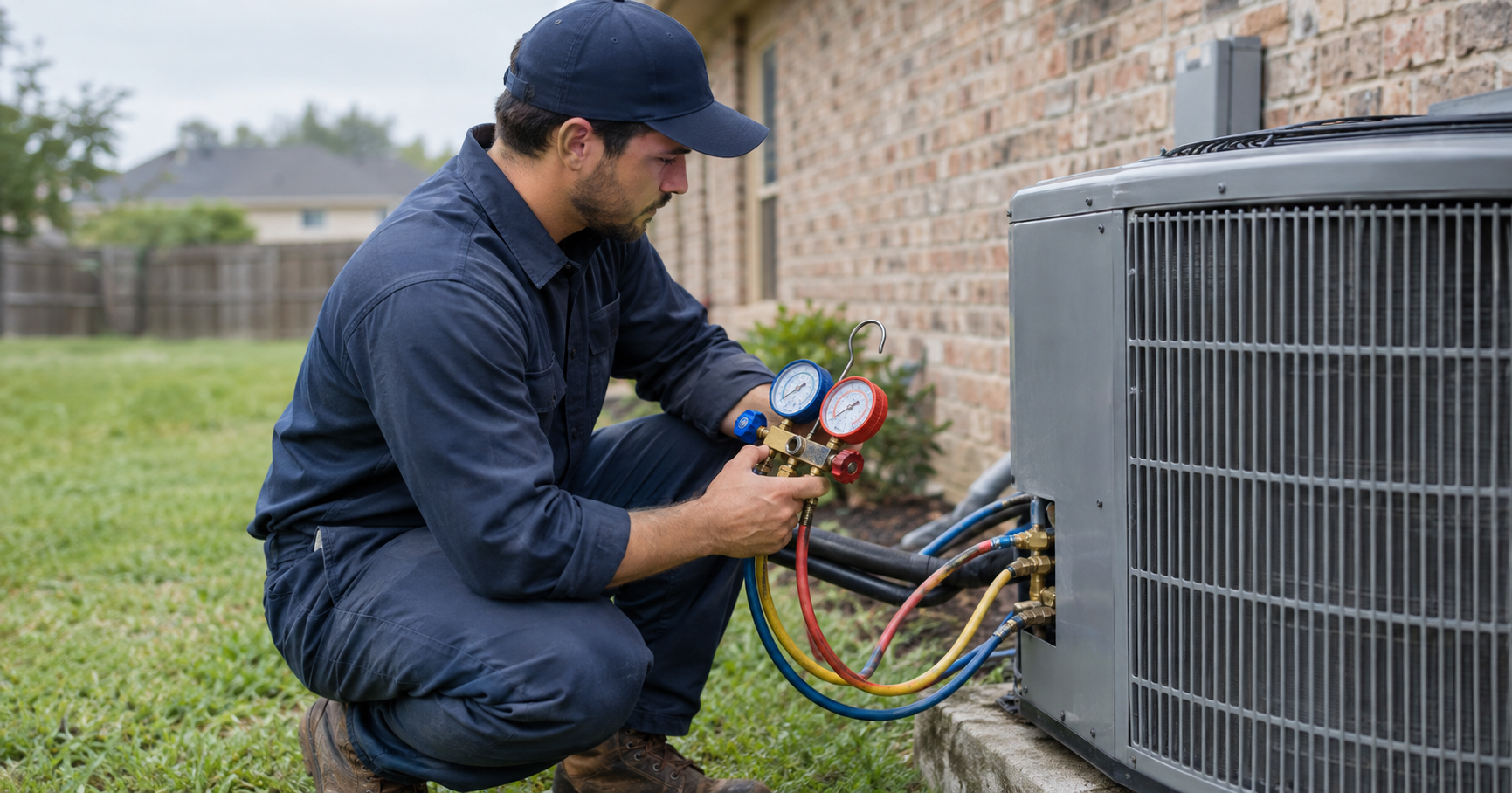
Remember: AC systems do not consume refrigerant. If your charge is low, you have a leak. Adding refrigerant without finding and fixing the leak means you are paying for a temporary improvement that will degrade again in 6 to 18 months. A proper refrigerant service call includes leak detection, leak repair, and then recharge — in that order. Our AC Repair service page explains what a complete refrigerant diagnostic includes and why we never top off without locating the source.
Reason 5 — Your Home's Envelope Is Letting Outdoor Humidity In
Your home's building envelope — walls, windows, doors, attic hatch, penetrations for plumbing and electrical — is the boundary between the humid NWA outdoor air and your conditioned indoor space. Every gap in that envelope is a humidity entry point.
Scenario 1: Your AC is failing but your gas furnace is relatively new.
In NWA's summer conditions, with outdoor relative humidity at 70 to 80 percent and indoor conditions at 50 percent, there is a continuous vapor pressure differential driving moisture from outside to inside. That moisture infiltrates through every unsealed gap, around every improperly weatherstripped door, through single-pane windows, and through electrical outlet boxes on exterior walls that lack air sealing.
<cite index="92-1">Warm Gulf air brings abundant moisture. Foundations and crawl spaces are especially vulnerable in our humid subtropical climate.</cite> Older NWA homes — those built before the 2000s energy code improvements — often have significantly more air infiltration than modern construction. A blower door test, which measures total home air leakage, is the definitive tool for quantifying how much outdoor air is infiltrating your home. Homes with high air infiltration rates have both higher energy costs and higher humidity loads than well-sealed homes of comparable size.
Simple envelope improvements that reduce humidity infiltration in NWA homes: weatherstripping on all exterior doors, caulking around window frames and trim, foam gaskets behind exterior outlet and switch cover plates, and attic hatch insulation and air sealing. These are genuine DIY projects that cost $50 to $200 in materials and can meaningfully reduce the moisture infiltration your system is fighting every summer day.
For homes with significant infiltration issues, a professional energy audit — which can identify the specific high-leakage locations using a blower door test and sometimes thermal imaging — provides a prioritized list of improvements. Some NWA homeowners who address their biggest infiltration points report that their existing AC system handles humidity adequately once the envelope load is reduced.
Reason 6 — Your System Has Not Been Maintained and Cannot Dehumidify Efficiently
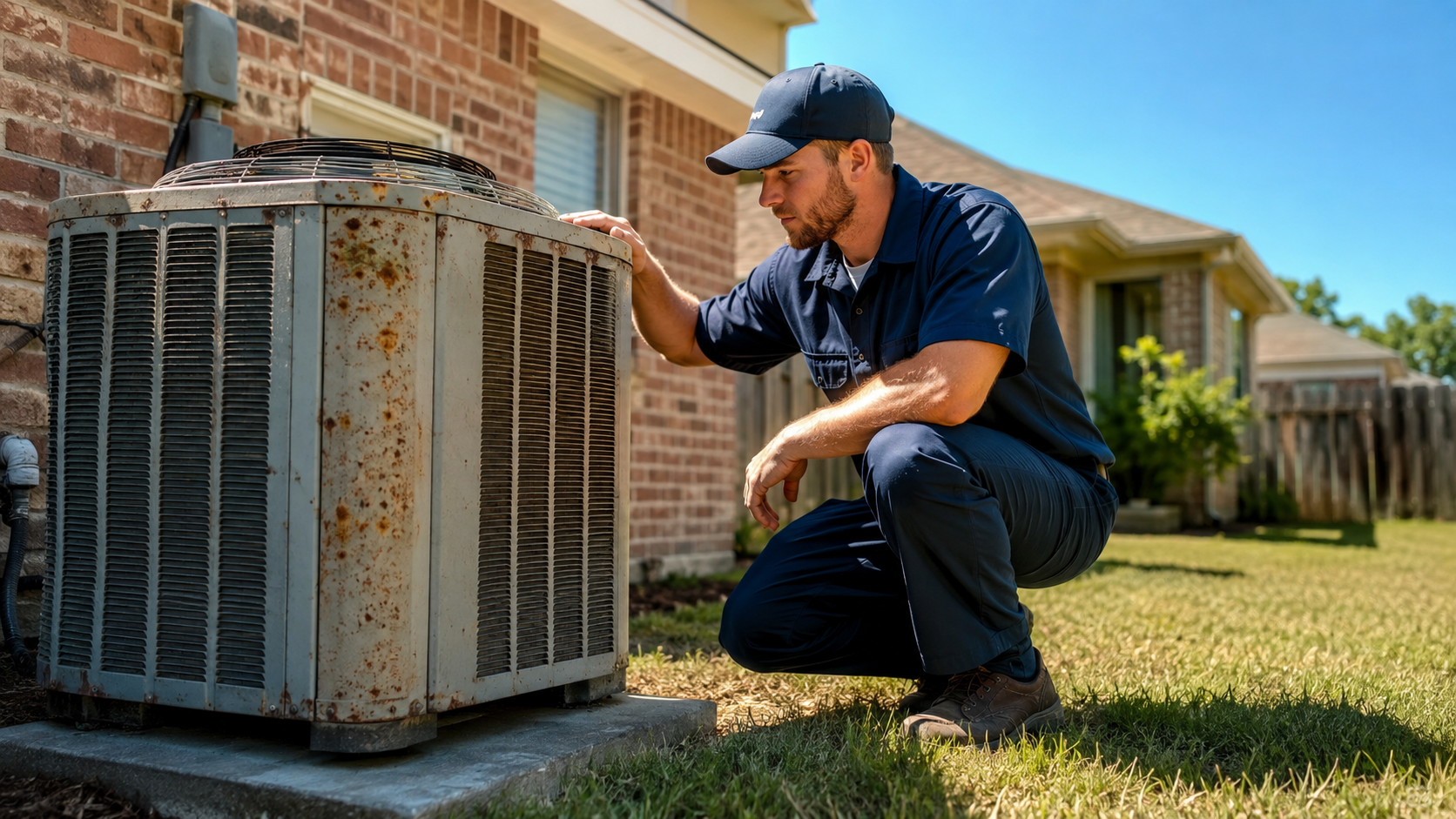
A dirty evaporator coil, a clogged condensate drain, or a failing blower motor can all reduce your system's dehumidification capacity without obviously reducing its cooling performance.
A dirty evaporator coil — coated with a thin layer of dust, pet dander, and biological growth — has reduced surface area for moisture condensation. The coil is still cold, but the layer of contamination acts as a thermal and moisture barrier, reducing both heat transfer and water removal. A coil cleaning restores dehumidification performance in addition to improving energy efficiency.
A clogged condensate drain line is the specific maintenance failure that converts an indoor humidity problem into potential water damage. The condensate pan beneath your evaporator coil collects the water dripping off the coil during normal operation. The drain line carries that water out of the house. When algae and biological growth clog the drain line — common in NWA's warm, humid attic environments — water backs up in the pan. <cite index="69-1">AC condensate water is initially clean but the biological growth in the drain line makes it gray water within 48 hours.</cite> A backed-up pan can overflow, causing water damage to ceilings, walls, and structural components below the air handler.
Prevention is simple: pour half a cup of white vinegar into the condensate drain access port monthly during cooling season. The vinegar controls algae growth and keeps the drain clear. A professional tune-up includes drain line cleaning and verification of proper condensate flow as a standard step. Our Total Breeze Club membership includes this inspection as part of the annual maintenance service.
The Mold Reality — Why NWA Humidity Problems Cannot Wait
We are going to be direct about this because it is the section most guides soften unnecessarily.
<cite index="70-1">In NWA summer humidity, mold can begin forming within 48 to 72 hours after materials become wet.</cite> This timeline is not a conservative estimate for worst-case conditions. It is the realistic timeline for NWA summer conditions specifically — warm, humid air, minimal temperature differential to slow biological activity, abundant organic material in building components.
A condensate drain backup that soaks your attic ceiling for three days can create a mold colony that does not become visible or odorous for another two to three weeks. By the time you smell the mustiness, the colony is established and remediation requires professional intervention — not just cleaning and drying.
<cite index="91-1">Over 5 million cases of asthma annually are attributed to residential dampness and mold. High levels of indoor humidity provide ideal breeding grounds for fungus, mold, and other unwanted bacterial growths.</cite> <cite index="90-1">Dust mites multiply rapidly in humid environments. These microscopic pests trigger allergies and asthma symptoms. They prefer humidity levels above 50 percent.</cite>
For NWA homeowners with family members who have asthma, allergies, or respiratory sensitivities, maintaining indoor humidity below 50 percent is not a comfort preference — it is a health management priority. The difference between a home at 45 percent relative humidity and a home at 65 percent relative humidity is the difference between a controlled and uncontrolled environment for dust mite reproduction and mold growth.
This is also why we address humidity problems proactively rather than waiting for visible evidence. By the time you see black spots on a bathroom ceiling or smell a persistent musty odor from a supply vent, the moisture problem is weeks or months old. Prevention — maintaining proper humidity through a functioning, correctly sized, properly maintained HVAC system — is far less expensive and disruptive than remediation.
The Solutions — From Simplest to Most Comprehensive
Once you have identified which of the six reasons applies to your home, here is the solution path ranked from simplest and cheapest to most comprehensive.
Solution 1 — Check and Replace Your Air Filter ($5 to $20)
A clogged air filter restricts airflow across the evaporator coil, raising coil temperature and reducing moisture condensation. In NWA summer, check your filter monthly. This is the first thing to do before anything else.
Solution 2 — Run Exhaust Fans Properly (Free)
Every shower: run the exhaust fan during the shower and for 20 minutes after. Every meal involving boiling, steaming, or frying: run the range hood. These behavioral changes can reduce your indoor moisture load by a measurable amount at zero cost.
Solution 3 — Professional AC Tune-Up ($75 to $250, partially offset by SWEPCO CoolSaver rebate of $175 to $250)
A professional tune-up addresses coil cleaning, drain line clearing, refrigerant pressure verification, and blower speed adjustment. For many NWA homes, a single tune-up restores dehumidification performance that has been gradually declining. The SWEPCO CoolSaver program rebate covers a significant portion of the cost for SWEPCO customers using an approved contractor.
Solution 4 — Duct Sealing ($800 to $3,000 depending on scope)
For homes where attic air infiltration through duct gaps is the primary driver, professional duct sealing addresses the root cause. SWEPCO also offers rebates on qualifying duct sealing work performed by approved contractors — making this a double efficiency and humidity improvement with partial utility program offset.
Solution 5 — Whole-Home Ducted Dehumidifier ($1,500 to $3,500 installed)
<cite index="84-1">A whole-house dehumidifier costs $1,100 to $3,500. Installing a dehumidifier in a basement or crawl space is $1,000 to $3,000 depending on size and drainage complexity.</cite>
For NWA homes where the AC is correctly sized and maintained but the humidity load from the climate, crawl space, or envelope simply exceeds what the AC can handle alone, a whole-home ducted dehumidifier is the definitive solution. These units integrate directly into your existing ductwork, monitor indoor relative humidity continuously, and run independently of your AC to pull moisture out of your home's air whenever humidity climbs above your setpoint — typically set to 50 percent.
Leading whole-home dehumidifier options for NWA in 2026 include the AprilAire E100 (100 pints per day, ENERGY STAR Most Efficient rated, appropriate for homes up to 3,000 square feet), the Santa Fe Ultra98 (98 pints per day, MERV-13 filtration, strong in NWA's humid conditions), and the Honeywell TrueDRY DR90 (90 pints per day, designed for HVAC integration). Installation typically takes 3 to 6 hours for a two-technician team and requires a condensate drain connection and ductwork tie-in.
The ongoing operating cost of a whole-home dehumidifier is modest — most units consume 5 to 8 kilowatt-hours per day when running, which at SWEPCO rates adds $10 to $15 per month to your electricity bill during peak summer operation. Against the comfort improvement, mold prevention value, and protection of your home's structure and contents, that operating cost is among the best investments an NWA homeowner can make.
Our Indoor Air Quality service page covers the full range of whole-home dehumidification and IAQ solutions we offer for NWA homes.
Solution 6 — Crawl Space Encapsulation ($5,000 to $15,000)
For NWA homes with unencapsulated crawl spaces contributing major moisture loads, crawl space encapsulation — sealing the crawl space floor and walls with a heavy-duty vapor barrier, adding a dedicated crawl space dehumidifier, and insulating the crawl space walls rather than the floor — is the comprehensive solution. It eliminates soil evaporation as a moisture source, reduces the humidity load on the HVAC system, and typically improves both comfort and energy efficiency measurably.
Solution 7 — System Replacement with Proper Sizing and a Variable Speed Unit ($6,500 to $10,000)
For homes where the humidity problem stems from a chronically oversized system that cannot be adequately corrected through blower speed adjustment, the long-term solution is replacement with a properly sized system using a Manual J load calculation. Modern variable-speed HVAC systems — including Rheem's variable-speed lineup and Mitsubishi's inverter-driven mini-splits — modulate their output capacity based on actual load conditions. A variable-speed system running at 60 percent capacity on a mild day produces longer run cycles and significantly better dehumidification than a single-stage system cycling on and off. Our Mini-Splits service page covers how Mitsubishi's inverter technology handles NWA humidity differently from traditional single-stage systems.
Frequently Asked Questions About Indoor Humidity in NWA
What is the ideal indoor humidity in summer in Northwest Arkansas?
The target is 30 to 50 percent relative humidity. In NWA summer, keeping indoor humidity at or below 50 percent is the primary goal — below 45 percent is ideal for allergy and asthma management. At 50 percent or below, dust mite reproduction is significantly suppressed and mold growth risk is low.
How do I know if my house has a humidity problem?
Buy a $10 to $30 hygrometer from any hardware store. Measure at 3 PM on a typical hot summer afternoon. If you read above 55 percent consistently, you have a humidity problem worth addressing. If you read above 60 percent, address it now. Physical signs include condensation on interior windows and supply registers, a musty or earthy odor, sticky feeling floors, and wood furniture or doors that swell and stick seasonally.
Can my AC alone control humidity in an NWA home?
In many cases, yes — if the system is correctly sized, properly maintained, and appropriately charged with refrigerant. But in homes with significant moisture sources (uncapped crawl spaces, leaky ductwork, high infiltration rates), or in homes where the AC is oversized and short-cycling, supplemental dehumidification through a whole-home ducted dehumidifier is often necessary for adequate humidity control.
Why does my house feel humid even when the AC is running?
The most common reasons specific to NWA: oversized system short-cycling before adequate moisture removal occurs; low refrigerant reducing coil temperature and moisture condensation; leaky return ducts pulling humid attic air into the system; or a moisture load from crawl space soil evaporation that exceeds the AC's dehumidification capacity. A professional diagnostic visit can identify which of these applies.
How much does a whole-home dehumidifier cost in NWA?
Installed cost runs $1,500 to $3,500 for a ducted whole-home unit, depending on capacity and installation complexity. The AprilAire E100 and Santa Fe Ultra98 are the most commonly installed units for NWA homes in the 1,500 to 3,000 square foot range. Operating cost adds approximately $10 to $15 per month during peak summer humidity conditions.
Does mold grow faster in NWA than in other parts of the country?
Yes, in summer specifically. Warm temperatures and high ambient humidity create conditions where mold can establish on wet materials within 48 to 72 hours. This timeline is faster than in drier or cooler climates. NWA homeowners should address any moisture intrusion — plumbing leaks, condensate drainage issues, or flood events — within 24 hours to minimize mold establishment risk.
What is a condensate drain and why does it matter?
The condensate drain carries water removed from your home's air by the evaporator coil out of the house. A typical NWA home's AC removes 5 to 20 gallons of water per day during summer operation — all of it must exit through this drain. A clogged drain backs water into the pan and eventually causes overflow and water damage. Monthly white vinegar treatment prevents clogging. Annual professional inspection confirms proper flow.
Can I fix a short-cycling humidity problem without replacing my system?
Sometimes. A professional can reduce blower fan speed on most air handlers to slow airflow across the coil, extending moisture contact time and improving dehumidification. This helps on mildly oversized systems. Severely oversized systems — units significantly larger than what a Manual J calculation would specify — often cannot be adequately corrected without replacement. Adding a whole-home dehumidifier alongside a short-cycling system is an alternative that avoids the replacement cost while solving the humidity problem.
Does Breeze Heat and Air handle humidity diagnostics in NWA?
Yes. We assess humidity conditions as part of any diagnostic visit and can evaluate whether your system's dehumidification performance matches what your home requires. Call 479.318.0107 or schedule online.
The Bottom Line — Comfort Is Temperature Plus Humidity
That homeowner walking into their 74-degree house that feels like a swamp is not imagining it. The discomfort is real, the cause is diagnosable, and the solution is almost always achievable without dramatic expense.
The most common NWA humidity scenario we see: an oversized system installed without a Manual J calculation, short-cycling through the summer, keeping the house technically cool but consistently above 60 percent humidity. A blower speed adjustment and a whole-home dehumidifier solve it completely. Two service calls and one equipment installation later, the house feels like a different building.
The second most common scenario: an uncapped crawl space in a 2004 Rogers or Springdale home pumping soil moisture into the floor assembly, overwhelming the AC's dehumidification capacity. Crawl space encapsulation eliminates the source. Indoor humidity drops by 10 to 15 percentage points within weeks.
The common thread: both scenarios are solvable. NWA's humid climate is not something you have to simply endure. With the right combination of HVAC maintenance, equipment sizing, and supplemental dehumidification, your home can consistently maintain 45 to 50 percent relative humidity through the longest NWA summer — without sticky floors, foggy windows, or that persistent musty smell from the back of the HVAC closet.
If your hygrometer is telling you what most NWA homeowners already feel — that the humidity is not under control — call Breeze Heat and Air at 479.318.0107 or schedule a diagnostic. We will identify the specific cause in your home and give you an honest, prioritized path from where you are to where you want to be.
We serve Bentonville, Fayetteville, Rogers, Springdale, Tontitown, Lowell, Farmington, Cave Springs, Siloam Springs, Pea Ridge, Gravette, Prairie Grove, Johnson, Elm Springs, and all of Northwest Arkansas. LIC# 15474066.
What humidity level is your home running right now? Share it in the comments with your home's approximate age and square footage — we will tell you whether that number points to a specific fixable cause or a normal NWA seasonal baseline.
Breeze Heat and Air — LIC# 15474066 — Rheem Pro Partner — Mitsubishi Diamond Dealer — Serving all of Northwest Arkansas
HVAC Resources for Northwest Arkansas Homeowners
Expert guidance on repairs, replacements, rebates, and maintenance — everything you need to make confident decisions about your home's heating and cooling.