August 3, 2026
7 Warning Signs Your HVAC System Needs to Be Replaced (NWA Homeowner's Guide)
The Repair Bill That Finally Made the Decision for Her
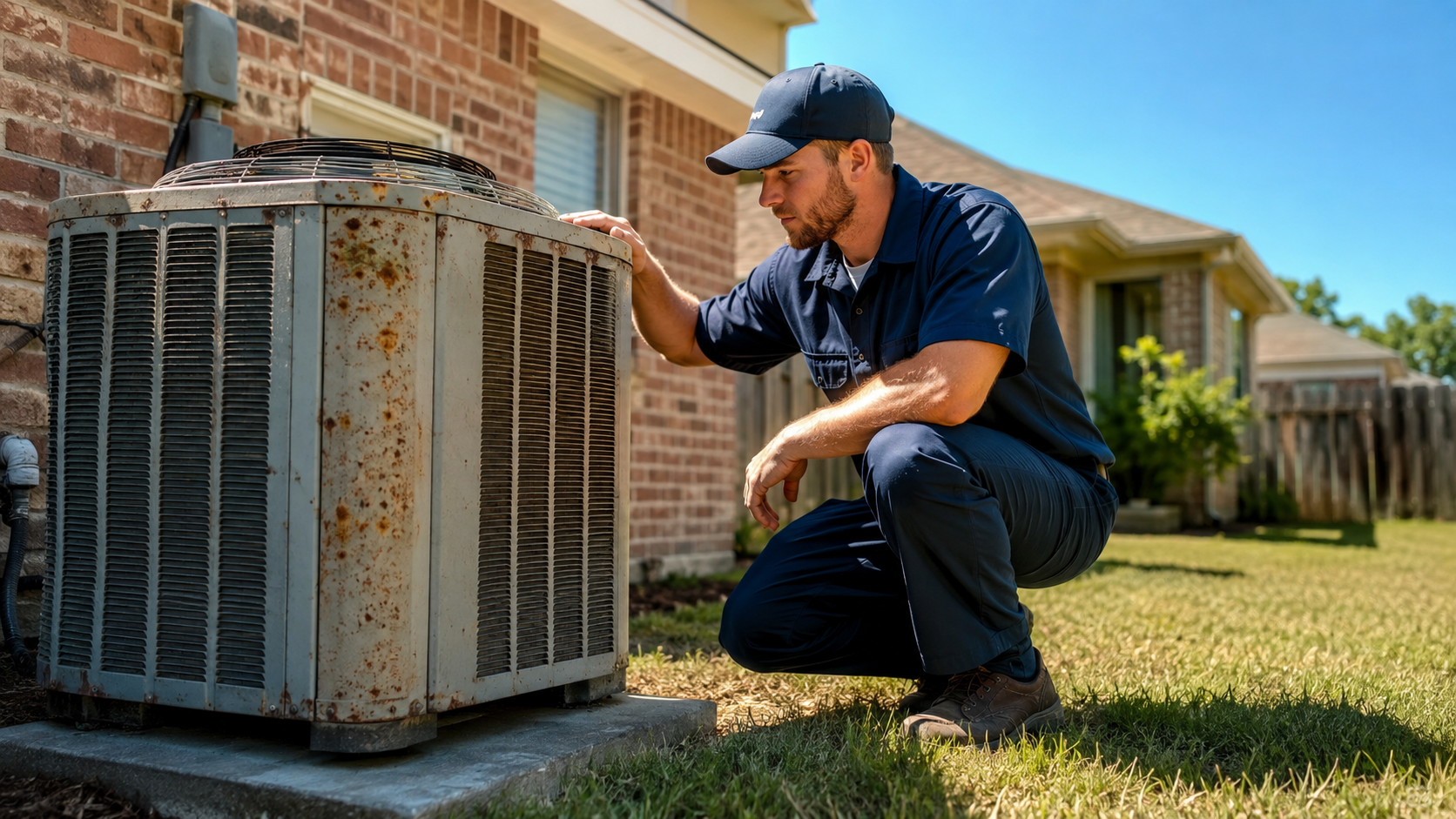
A homeowner in Rogers called us in June after getting a $1,750 repair quote from another company. Compressor running hot, capacitor already failed once the summer before, refrigerant low again. She wanted a second opinion.
We came out, ran a full diagnostic, and told her what she already suspected but did not want to hear: the repair was not worth it. Her system was 16 years old. She had spent $580 the previous summer on a capacitor and refrigerant recharge. The new compressor quote — $1,750 — would bring her two-year repair total to $2,330 on a system running at maybe 60% of its original efficiency. A new system would cost her $6,800 installed. Synchrony financing brought that to manageable monthly payments. And her August electricity bill dropped $64 compared to the same month the year before.
The decision she agonized over for two weeks was, in retrospect, obvious. She just needed someone to show her the full picture.
That is exactly what this guide does.
Northwest Arkansas is in the middle of a replacement wave right now. Thousands of homes built during the region's construction boom of the late 1990s through the mid-2000s — in subdivisions across Bentonville, Rogers, Springdale, and Fayetteville — were equipped with HVAC systems that are now 15 to 25 years old. The average central AC system lasts 15 to 20 years according to the American Society of Heating, Refrigerating and Air-Conditioning Engineers (ASHRAE). The average gas furnace runs 15 to 25 years. Heat pumps, which work year-round, typically last 12 to 17 years.
Do the math. An enormous portion of the NWA housing stock is running equipment at or past end-of-life right now. Many homeowners know something feels off — the bills are higher, the house never feels quite right, the technician came out twice last summer — but they are not sure when "keep repairing" becomes "time to replace."
This guide gives you the seven specific, measurable warning signs that experienced HVAC technicians use to make that determination. Not vague feelings. Specific patterns that, when two or more appear together, mean your system is telling you something worth listening to.
Why Replacement Timing Matters More in NWA Than Most People Realize
Before we get into the seven signs, here is a context point that changes how you should read this guide.
The best time to replace an HVAC system is not when it fails. It is before it fails. And in NWA, that distinction carries extra weight for three specific reasons.
First, NWA summers are genuinely dangerous when cooling fails. This is not an exaggeration. In the past two weeks, the National Weather Service placed all of Northwest Arkansas under heat advisories with heat index values above 110 degrees. Fayetteville opened an emergency cooling center. The Department of Energy declared an energy emergency for Arkansas. When your HVAC system fails at 107 degrees, you are not just uncomfortable — you are in a situation that affects vulnerable family members, pets, and anyone without easy access to an alternative cooling location.
Second, replacement lead times stretch during peak season. HVAC companies across NWA are running at full capacity in July and August. Equipment availability from distributors tightens. If your system quits on a Wednesday afternoon in late July, the fastest replacement timeline is days, not hours. Homeowners who replace in March, April, or October — the shoulder seasons — get faster scheduling, full equipment selection, and sometimes better pricing. The homeowner who waits until failure pays a premium in stress, emergency service costs, and limited options.
Third, replacement lets you capture SWEPCO rebates strategically. A homeowner who identifies a failing system in April can schedule a qualifying heat pump installation at a SWEPCO-tier that earns $1,200 to $2,000 in rebates, handled properly by an approved contractor before installation. A homeowner who replaces in emergency mode in August is focused on getting cooling back, not on optimizing rebate tiers. Same money available. Very different outcomes. Our full NWA HVAC Rebates guide covers how that process works.
With that context established, here are the seven warning signs.
Warning Sign 1 — Your System Is 12 to 15 Years Old and Has Had Two or More Repairs in the Past 24 Months
This is the most reliable predictor of impending failure that we see in the field — and it is the combination that matters, not either factor alone.
A 15-year-old system with no repair history is a very different conversation than a 12-year-old system that has needed service three times in two years. Age is context. Repair history is evidence.
Here is what happens mechanically as HVAC systems enter their second decade in service: small components fail first — capacitors, contactors, fan motors. These are wear parts that degrade from heat, vibration, and thousands of on-off cycles. Replacing them is reasonable. But their failure is also a signal that the larger components — compressor, heat exchanger, evaporator coil — are subject to the same years of wear. You cannot see inside a compressor, but you can see the pattern of what has been failing around it.
ASHRAE's published median service life for residential central air conditioning equipment is 15 years. That is a median, meaning half of all units fail before that point and half after. A unit that has crossed 12 years and is producing repair calls is trending toward the lower half of that distribution.
The specific threshold we use: if a system is over 12 years old and has needed two or more repairs in 24 months, the next significant repair conversation should include a serious evaluation of replacement. Not necessarily immediate replacement — that depends on what the repair is and what the rest of the system looks like. But the default answer of "just fix it again" stops being the right default at that combination of age and repair frequency.
In the NWA context, this sign applies most urgently to homes built between 2000 and 2010 whose original HVAC systems have never been replaced. If you bought a home in Bentonville's southwest neighborhoods, Rogers' newer subdivisions, or anywhere in Fayetteville's east-side growth corridors in that era and have the original system, do the math on its age and repair history before this summer gets any hotter.
Warning Sign 2 — Your Energy Bills Have Increased 15% or More Without a Change in Usage
This is the warning sign that most NWA homeowners notice first — and most incorrectly attribute to rising electricity rates rather than equipment degradation.
Both things happen. Arkansas electricity rates have risen over the past several years. But when rates rise, bills rise proportionally across all months. When your July bill climbs 20% while your January bill climbed only 5%, the pattern points to something specific to cooling: your AC is working significantly harder to produce the same result.
Here is the mechanical reality behind that pattern. An AC system that was rated at SEER 12 when it was installed 15 years ago may actually be operating at SEER 8 or 9 today due to accumulated refrigerant loss, coil fouling, compressor wear, and declining motor efficiency. That degraded system consumes 25% to 40% more electricity to produce the same cooling output as it did when new. In NWA, where cooling seasons run from late April through October — six full months — that monthly efficiency penalty compounds into a significant annual cost.
The math is concrete. Consider a 2,000 square foot home in Springdale running a 3-ton SEER 12 unit from 2008. A modern SEER2 16 replacement performs roughly 33% more efficiently. At Arkansas's average electricity rate of 13.3 cents per kilowatt-hour, that efficiency gap translates to $40 to $80 per month in reduced cooling costs — $240 to $480 per year. Over a 15-year replacement lifespan, that efficiency savings represents $3,600 to $7,200 in avoided electricity costs before we factor in efficiency degradation on the aging unit.
Put differently: the aging system is already charging you a hidden monthly tax. The question is whether that monthly tax, accumulated over the remaining years of the old system's uncertain life, is worth more than the cost of a new system.
How to identify this sign precisely: pull your electricity bills from the past three Augusts. Compare them to occupancy and thermostat settings during the same period. If you have added no square footage, changed no major appliance, and made no behavioral changes — and the bills are climbing — your system is losing efficiency. That trend accelerates, not stabilizes, as systems age further.
Warning Sign 3 — Your Home Has Persistent Hot Spots or Rooms That Never Cool Properly
One or two rooms in your house that are always 5 to 8 degrees warmer than the rest. The upstairs master bedroom that never gets comfortable no matter what you do with the thermostat. The bonus room over the garage that stays hot from June through September.
This is different from normal temperature variation. Every home has some temperature stratification — heat rises, rooms with more sun exposure run warmer. What we are describing is persistent, unresolvable discomfort that has gotten noticeably worse over the past two to three years.
When an aging HVAC system loses the capacity to adequately condition your whole home, hot spots are often the first manifestation. The system is working at full effort — it runs longer cycles, the compressor cycles on and off more frequently — but it cannot generate the same pressure differential in the refrigerant circuit that it produced when new. The result is uneven distribution: rooms close to the air handler cool adequately while rooms at the end of duct runs do not.
Here is the diagnostic nuance that separates "ductwork problem" from "system capacity problem." Ductwork issues — leaks, disconnections, collapsed flex duct — typically produce sudden changes in room comfort. You had a room that was fine last summer and now it is not. Capacity degradation from an aging system produces gradual worsening over multiple seasons. If you find yourself saying "this room has been getting worse every summer for the past three or four years," that trajectory points to system capacity loss, not a discrete ductwork failure.
In NWA homes with systems from the early 2000s construction era, we also see a related issue: the original system was slightly undersized for the home's actual load when installed, and that sizing error was tolerable when the equipment was new and running at full efficiency. As efficiency degrades with age, a marginal system becomes an inadequate system. No amount of repair brings back what was never fully there to begin with.
Our HVAC Installation service page covers how proper Manual J load calculation prevents this problem from repeating on a replacement system.
Warning Sign 4 — You Have Spent More Than $1,500 in Repairs Over the Past 36 Months
This is the cumulative cost warning that most homeowners miss because they are evaluating each repair in isolation rather than tracking the pattern.
A $400 capacitor and refrigerant recharge in 2023. A $680 fan motor in 2024. A $650 refrigerant recharge and leak repair in 2025. Individually, each of those felt like a manageable repair on a system that "still works." Together, they represent $1,730 spent on a system that is still at end-of-life — and the next failure is coming.
The $5,000 Rule provides a useful calculation here: multiply your system's age by the current repair quote. If the result exceeds $5,000, replacement is typically the better financial choice. A 14-year-old system with an $800 repair quote: 14 x $800 = $11,200, well over $5,000, pointing strongly toward replacement. But even without this specific formula, cumulative repair spending above $1,500 in three years on an aging system is money that would have been better applied toward a new installation.
There is a pattern we see regularly in NWA service calls that we think of as the failure cascade. The first repair is isolated — a capacitor, a contactor. The second repair, six to eighteen months later, involves a different component — a fan motor, a refrigerant issue. By the third or fourth repair, multiple systems are showing wear simultaneously. Components that have been stressed by the failing ones around them begin failing at shorter intervals. The cascade accelerates.
If you can track two or three distinct repair visits on your current system over the past three years, you are likely looking at the beginning of that cascade. The next repair bill is the moment to calculate cumulative spend and compare it honestly to replacement economics.
Warning Sign 5 — Your System Uses R-22 Refrigerant
This one is a hard stop. If your AC system was manufactured before 2010 and has not been replaced, there is a very high probability it uses R-22 refrigerant — and any refrigerant-related repair on that system deserves immediate replacement consideration.
R-22 production and import ended permanently on January 1, 2020, under the Montreal Protocol phase-out. By 2026, the remaining stockpiles of reclaimed R-22 refrigerant are extremely scarce and exceptionally expensive. What cost $20 per pound in 2015 now costs $150 to $250 per pound — when you can find it at all. A system that needs even a modest R-22 recharge of 3 to 4 pounds can generate a refrigerant bill of $450 to $1,000 before any leak repair or labor is added.
The situation is not improving. It is getting worse each year as existing stockpiles deplete and the installed base of R-22 equipment shrinks too slowly relative to the available refrigerant supply. The economic reality of R-22 refrigerant in 2026 means that any R-22 system requiring refrigerant is functionally at end-of-life from a repair economics standpoint.
How to check: look at your outdoor condenser unit. There is a data plate on the side panel. Find the line that says "refrigerant type" or "refrigerant charge." If it reads R-22 or HCFC-22, you have an R-22 system. If the data plate shows R-410A, you are using the current generation refrigerant — which has its own phase-down underway but is nowhere near R-22's cost and availability situation.
An important clarification: if your R-22 system is running fine and does not need refrigerant work, you do not need to replace it immediately based on refrigerant type alone. But you should be planning for replacement within the next one to two maintenance cycles. And if it develops any refrigerant leak, the replacement conversation moves to now. Our AC Repair service page includes what our diagnostic process looks like when we identify refrigerant issues.
Warning Sign 6 — Unusual Sounds That Were Not There Two Seasons Ago
A properly functioning HVAC system is not silent, but it has a consistent, predictable sound profile. When that profile changes, something inside the system has changed — and the question is what.
Here are the specific sounds that warrant professional evaluation in NWA homes:
Grinding or metal-on-metal scraping from the outdoor unit indicates bearing failure in the compressor or fan motor. Bearings do not heal. Once grinding begins, the component is failing and the timeline to total failure is measured in weeks, not months. On a system over 12 years old, grinding from the compressor is a replacement conversation, not a repair conversation. Compressor replacement on an aging system pushes into the 50% Rule territory almost always.
Banging or clanking from the outdoor unit suggests a loose or broken component — a fan blade that has shifted, a compressor mounting that has failed, or internal compressor damage where a rod or piston has come loose. This is never a normal aging sound. Turn the system off immediately if you hear banging and call for service. Running the system with loose internal components extends the damage.
Squealing from the indoor air handler indicates either a belt drive issue (older systems) or a blower motor bearing beginning to fail. Unlike outdoor unit grinding, indoor squealing on a newer direct-drive system often means the blower motor is approaching failure. A blower motor replacement on a system under 10 years old is a reasonable repair. On a system over 15 years old, evaluate the cumulative cost alongside replacement.
Clicking sounds at start-up and shutdown are normal. Clicking that continues during operation, or clicking that repeats 10 to 20 times before the system starts, indicates a relay or control board issue.
Popping or cracking sounds from your furnace — particularly on start-up or shutdown, and particularly if accompanied by a chemical or metallic odor — can indicate a cracked heat exchanger. This is not an efficiency issue. A cracked heat exchanger can allow carbon monoxide to enter your home's air stream, turning a mechanical problem into a safety emergency. Carbon monoxide is colorless and odorless — you will not smell it without chemical combustion byproducts also present. This is why we say every NWA home should have a carbon monoxide detector on each occupied floor.
If your furnace is over 15 years old and showing any of these sounds, especially combined with unexplained headaches or dizziness among occupants when the heat is running, shut the furnace off and call for service immediately. Do not run the system until a professional has inspected the heat exchanger. A cracked heat exchanger on an aging furnace is a replace-immediately situation — cracks cannot be safely repaired, and the risk of running a compromised heat exchanger is not worth any cost savings.
Warning Sign 7 — The System Cannot Manage NWA Humidity Anymore
This is the most underrated warning sign on this list — and the one that NWA homeowners are most likely to attribute to something other than their HVAC system.
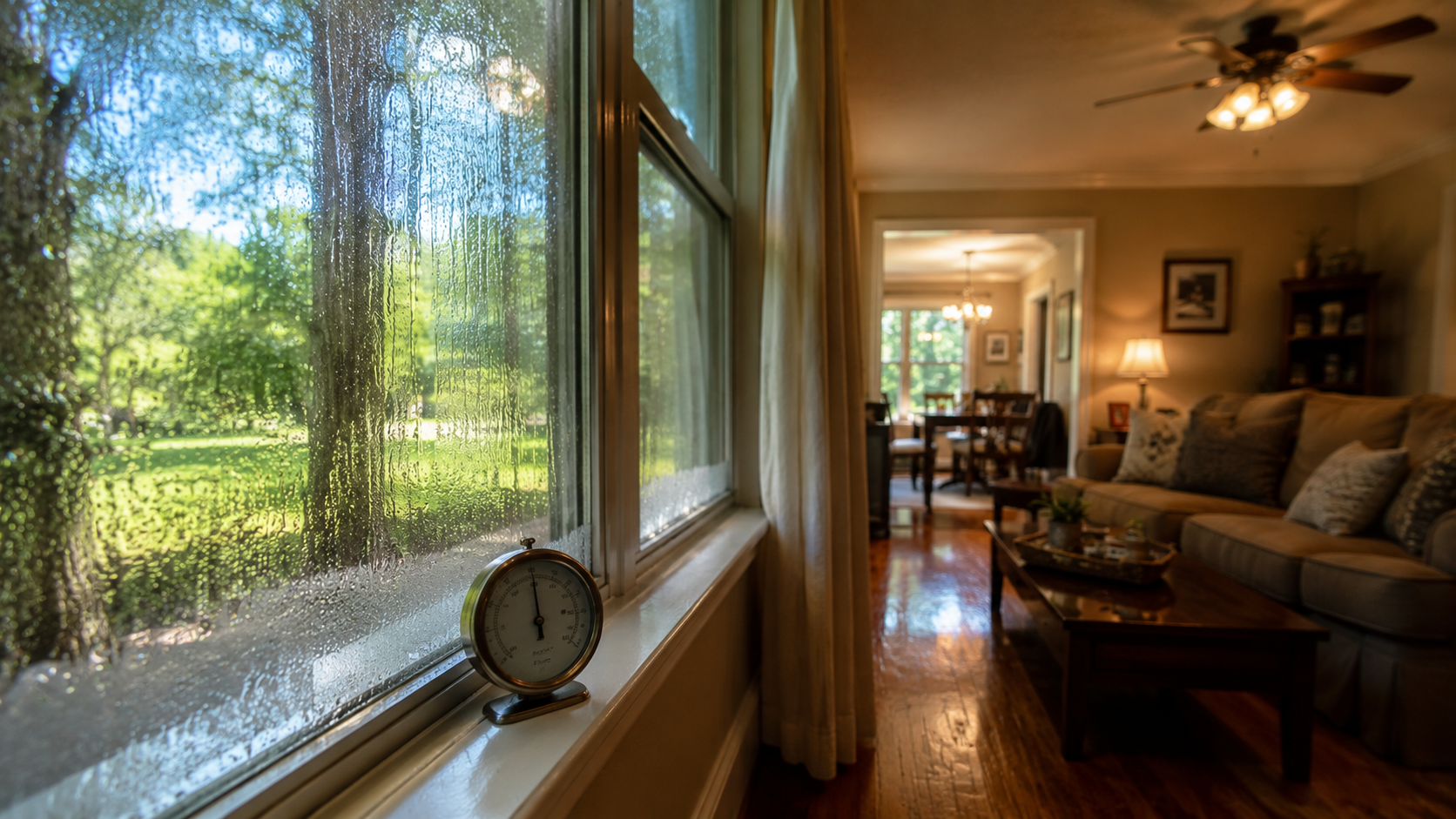
Your AC does two things simultaneously: it cools air and it removes humidity. Those two functions are linked mechanically. A properly functioning system moving air across a properly charged, correctly sized evaporator coil removes moisture from that air as a byproduct of the cooling process. When your home feels cool but damp — when wooden floors feel slightly sticky, when the house has a heavy, close feeling even at 72 degrees, when window condensation appears on interior surfaces — your system is failing the dehumidification part of its job.
In Northwest Arkansas's Climate Zone 4A, summer humidity management is not a luxury — it is what makes indoor temperature livable. An outdoor temperature of 95 degrees with 70% relative humidity creates heat index values well above 100 degrees. Indoors, maintaining 72 degrees at 60% or lower relative humidity is what actually makes your home comfortable. If you are hitting the temperature number but the humidity is wrong, the house does not feel like 72 degrees. It feels like 78.
When aging HVAC systems lose the ability to dehumidify adequately, it usually means one of two things: the refrigerant charge has degraded enough that coil temperature is no longer dropping adequately below the dew point, or the system has been running short cycles due to oversizing or reduced capacity — which produces cooling without adequate humidity removal because moisture removal requires sustained coil contact time.
Both of these conditions are age-related. Neither is easily or cheaply fixed through repair on an aging system. A new system, properly sized using Manual J load calculation and installed with attention to NWA's specific climate characteristics, resolves humidity management problems that years of repairs on an aging system cannot address. For homes dealing with humidity issues specifically, our Indoor Air Quality service page also covers supplemental dehumidification options that can complement a new system installation.
How Many Signs Does It Take?
Here is the honest answer: it depends on which signs and which combinations.
One sign alone (usually wait):
An old system that runs perfectly, cools evenly, manages humidity, and has no repair history is worth running until other signs appear. Age alone is not a replacement trigger — it is context that makes other signs more urgent.
Two signs together (evaluate seriously):
Energy bills climbing 15% plus one major repair in 24 months on a 13-year-old system. That combination is worth getting a replacement quote alongside the next repair quote, so you are comparing real numbers rather than gut feelings.
Three or more signs (replacement almost certainly the right answer):
A 15-year-old system with two prior repairs, rising energy bills, and rooms that cannot be cooled adequately is displaying every symptom of end-of-life equipment. At that point, the next repair bill is almost certainly the wrong investment. The money belongs toward replacement.
Any sign involving R-22 refrigerant damage or a suspected cracked heat exchanger (replace immediately):
These are not negotiating points. R-22 refrigerant repair economics are irrational in 2026. A cracked heat exchanger is a carbon monoxide safety issue. Both require replacement decisions measured in days, not months.
What to Do Right Now If You Recognize These Signs
The step most NWA homeowners skip — and regret — is getting a replacement quote before the system fails completely. Here is why that matters practically.
When you get a replacement quote while your system is still running, you have time. Time to compare two or three estimates. Time to choose your efficiency tier thoughtfully rather than defaulting to whatever is in stock. Time to process the SWEPCO rebate reservation form before the installation date — which requires pre-approval and cannot be done retroactively. Time to arrange Synchrony financing rather than making an emergency decision under financial pressure.
When you wait until the system quits on a 105-degree August afternoon, you have none of those options. You take what is available, pay whatever the emergency rate is, and make a $7,000 decision in 45 minutes.
The shoulder season — March through early May, and October through November — is the strategic window for NWA replacement planning.
Scheduling is easier, lead times are shorter, and SWEPCO pre-approval can be completed without the summer backlog that affects processing times. A homeowner who identifies warning signs today and schedules a replacement consultation this week is in a fundamentally better position than the same homeowner who waits until August. The
Total Breeze Club membership includes annual system assessments specifically designed to identify these warning signs before they become emergencies.
The NWA-Specific Factors That Accelerate System Decline
Generic HVAC guides cover warning signs without the local context that determines how urgently they apply. In Northwest Arkansas, three specific factors accelerate system aging compared to national averages.
Attic-mounted air handlers in the heat
A significant portion of NWA homes from the 2000s construction era have air handlers located in unconditioned attic spaces. In July, those attics reach 140 to 160 degrees Fahrenheit. Electrical components, control boards, and capacitors in attic air handlers run at temperatures that dramatically shorten their service life compared to basement or closet-installed units in conditioned space. If your air handler is in your attic and your system is over 10 years old, the warning signs on this list apply at a more compressed timeline.
Climate Zone 4A humidity demands
NWA sits in ASHRAE's mixed-humid climate zone, meaning systems run hard through a 6-month cooling season with high humidity loads. Heat pumps in this zone run year-round — cooling in summer, heating in winter — accumulating wear on the compressor far faster than AC-only units in more moderate climates. ASHRAE's rated lifespan of 12 to 17 years for heat pumps assumes typical use conditions. NWA heat pumps at the 12-year mark have accumulated more operational hours than the same unit in a milder climate.
The 2000s construction wave
Northwest Arkansas grew explosively between 1995 and 2010, driven by Walmart's supplier network expansion and Tyson Foods growth. That construction wave installed enormous numbers of HVAC systems that are now hitting simultaneous end-of-life. The regional market is absorbing that replacement demand alongside ongoing new construction. Technicians are busy. Equipment lead times matter. The homeowner who plans ahead gets better outcomes than the homeowner who waits for failure.
Frequently Asked Questions About HVAC Replacement in NWA
How do I know if my HVAC system is too old to repair?
Age alone is not the answer — the combination of age, repair history, and current warning signs is. A system over 15 years old that has had two or more repairs in 24 months and shows rising energy bills is almost certainly past the point where repair makes financial sense. Use the $5,000 Rule: multiply the system's age in years by the current repair quote. Over $5,000, lean toward replacement.
What is the average lifespan of an HVAC system in Northwest Arkansas?
Central AC systems average 15 to 20 years per ASHRAE benchmarks. Gas furnaces run 15 to 25 years. Heat pumps, which run year-round in NWA's climate, average 12 to 17 years. In NWA's attic-mounted configurations and hot, humid climate, systems at the lower end of those ranges are more common than in milder markets.
Can my HVAC system be too old to qualify for SWEPCO rebates?
No — the SWEPCO rebate is based on the new equipment you install, not on what you are replacing. Any system being replaced with a qualifying heat pump at SEER2 15.2 or above earns the rebate regardless of how old the system being removed is. Our NWA HVAC Rebates guide covers the complete process.
Should I replace my AC and furnace at the same time?
In most cases, yes — especially if they are close in age. Replacing only the outdoor condenser while keeping an aging, mismatched indoor coil or air handler reduces efficiency, can void the warranty on the new outdoor unit, and defers a second replacement project within a few years. AHRI certification requires matched system pairs for rated efficiency. When one major component needs replacement, evaluate the complete system.
How much does HVAC replacement cost in NWA?
A standard central AC replacement for a typical NWA home runs $5,500 to $8,500 installed. A heat pump system, which covers both cooling and heating, runs $6,500 to $10,000. After SWEPCO rebates of $750 to $2,400 depending on system size and efficiency tier, the net cost is meaningfully lower. Synchrony Bank financing makes the out-of-pocket manageable from day one.
What is a cracked heat exchanger and how dangerous is it?
The heat exchanger in your furnace is the metal barrier that separates combustion gases from the air circulating through your home. When it develops cracks — a common failure mode in furnaces over 15 years old — carbon monoxide can enter your home's air supply. Carbon monoxide is colorless and odorless. Every NWA home should have carbon monoxide detectors on every occupied floor. If a technician identifies a cracked heat exchanger, shut the furnace off and do not restart it until the exchanger is replaced or the system is replaced entirely. This is a safety issue, not a financial one.
Is it worth replacing an HVAC system before it completely fails?
Almost always yes, for NWA homeowners specifically. Pre-failure replacement gives you time to compare quotes, choose your efficiency tier, capture SWEPCO rebates through proper pre-approval, and schedule during a non-emergency window. Emergency replacement in peak summer is faster and more expensive, with fewer choices. The homeowner who identifies warning signs and replaces proactively consistently gets better financial and comfort outcomes than the homeowner who waits.
Does Breeze Heat and Air offer free replacement quotes?
es. Replacement consultations are always free — no service call fee, no commitment, just a complete system assessment and installed pricing with all available rebates and financing options presented transparently. Call 479.318.0107 or schedule online.
How do I find out how old my HVAC system is?
Look at the data plate on your outdoor condenser unit. It lists the manufacturer, model number, and serial number. The serial number encodes the manufacturing date in a format that varies by brand. Rheem serial numbers encode the manufacturing week and year in the first four characters. If you cannot decode the serial number, call us at 479.318.0107 and we can identify the age from the model and serial number in about two minutes.
The Honest Conclusion
The homeowner in Rogers whose story opened this guide was not making a bad decision by trying to repair her system one more time. She was making the decision most people make when they do not have the complete picture. She needed someone to sit with her, run through the numbers on both options, and give her an honest comparison.
That is what we do at Breeze Heat and Air. Not push replacement when repair is the right answer. Not push repair when replacement is the right answer. Give you the information you need to make the decision that is right for your home, your system, and your budget.
If you recognize two or more of the seven warning signs in this guide — especially if your system is from the 2000s construction wave that built out Bentonville, Rogers, Springdale, and Fayetteville — a free replacement consultation before your system forces the decision is worth 45 minutes of your time.
Our
AC Repair vs. Replace guide goes deeper on the financial decision framework if you want to work through the numbers before calling. And our AC Repair Cost guide gives you the component-by-component pricing context to evaluate any repair quote you receive.
When you are ready to have the conversation, call Breeze Heat and Air at 479.318.0107 or schedule a free consultation. We serve Bentonville, Fayetteville, Rogers, Springdale, Tontitown, Lowell, Farmington, Cave Springs, Siloam Springs, Pea Ridge, Gravette, Prairie Grove, Johnson, Elm Springs, and all of Northwest Arkansas. LIC# 15474066.
What sign on this list surprised you most? If your system is showing any of these patterns, share it in the comments — we read every one and will give you an honest take on what it means for your specific situation.
Breeze Heat and Air — LIC# 15474066 — Rheem Pro Partner — Mitsubishi Diamond Dealer — Serving all of Northwest Arkansas
HVAC Resources for Northwest Arkansas Homeowners
Expert guidance on repairs, replacements, rebates, and maintenance — everything you need to make confident decisions about your home's heating and cooling.